Showing posts with label social media. Show all posts

Thursday, July 27, 2017

To Respond, or Not to Respond

Image result for facebook comments suck

A Discussion Between 
Prof Thug and Stoned Willy Poonhound on 
Responding to Facebook Comments


Prof Thug: Hey Willy!

Stoned Willy Poonhound: Professor.

PT: Thanks for joining me today.

SWP: Eh. What else I gotta do.

PT: True. You're a homeless dog.

SWP: "Wanderin tha planet searchin fer truth" n "homelessness" are not tha same.

PT: Right. Well I thought I'd get together with you to talk about something that's been on my mind a lot lately. With this disaster of an administration running this country, there's no shortage of things to get outraged about. And where else to express that outrage but Facebook.

SWP: Obvi.

PT: And express outrage I do. But I've been thinking about why exactly I respond to hateful, ignorant Facebook comments...

SWP: Ya could jus say Facebook comments.

PT: ...especially from people I don't know. Posting on my own page is one thing; it's a way to vent, to express myself, to share interesting things, all that good stuff. But I've been considering for some time now whether replying to hateful comments on other friend's pages or on the news pages is at all helpful. Or healthy.

SWP: Ok. So why ya do it?

PT: Well, I consider myself a teacher, and writer, and not just as a profession; I try to teach and write wherever possible. Deep down, I feel like I can teach a few people about a few things, you know?

SWP: Sure. So what's tha problem?

PT: The problem is, the asshole making the ignorant comments is not going to change his or her mind, so who am I really teaching?

SWP: Ya think anyone ever changed their mind cuz a sum comment they saw online?

PT: I think I may have changed one mind on one single topic in the years I've been on Facebook.

SWP: If ya know that, why do it?

PT: Well, Facebook is social. Comments can be read by other people. Maybe there is someone out there whose mind is not made up and they will be swayed by my argument. Or maybe someone out there is offended by the ignorant comment but too timid to say anything, and maybe they will feel empowered by seeing someone else sticking up for them.

SWP: That's fair. But if yer 118 comments deep in a sub-thread, is anyone really reading it besides the few people gettin tha notifications?

PT: Maybe, maybe not. The thing is, I also consider myself a student of life, and conversation is a great way to learn. Even if the conversation is with a big dumb dumb, you can learn a lot from what dumb dumbs say. They reflect society's problems. Plus, I believe it's important to engage with people who have differing opinions and worldviews.

SWP: Avoidin tha bubble n all that.

PT: Exactly. Discussing your beliefs helps shape and strengthen those beliefs. Facebook commenting provides great practice in discourse.

SWP: Yeah, but sometimes yer comments seem kinda...assholeish. That improves discourse?

PT: I'm not perfect. I can't deny that my inner asshole can sometimes take over, especially when confronted by bigotry or hate.

SWP: I can relate. No mercy fer bigots.

PT: Absolutely. But...

SWP: What?

PT: I often end up regretting commenting.

SWP: Why?

PT: Well it usually breaks down into insults when facts and reason don't seem to work. And I don't really mind that, it just seems counter-productive.

SWP: Not really teachin anybody at that point...

PT: Right. Another thing: sometimes seeing how much ignorance and hate is really out there gets to me.

SWP: Disillusioned wit tha world n shit?

PT: Exactly. Like, how have these people gotten this far in life being so stupid?

SWP: I ask myself that same question bout tha human race as a whole. All tha damn time.

PT: Funny.

SWP: No, seriously.

PT: You're probably right. We are the literal worst. As evidenced by Facebook comments.

SWP: Yup.

PT: I just try to bring a little light or sanity or reason into the conversation.

SWP: But ya cant help breaking down inta insults...

PT: Yeah. Look, I'm trying. That's why I'm talking it out here.

SWP: Lemme ask ya this: Hav ya considered...not replyin ta ignorant comments?

PT: I...well...

SWP: Yeah?

PT: It's just...

SWP: Spit it out.

PT: I CAN"T STOP, WILLY! I tried, I swear. It just feels so good to shout my knowledge at everybody! It feels soo good to shut down an ignorant piece of shit! I know it's not helpful but making someone look foolish online is one of my favorite things to do ohmygod I love it so much! But it's killing me, Willy. It's tearing my soul apart. I want to be a teacher and I want to spread love... but it feels SOOOOO good to own these clowns!

SWP: I get it.

PT: It's childish. It's pointless. It just adds to the divisiveness and the tension in this country and I hate it. But I can't stop.

SWP: I understand. You want to feel powerful.

PT: It fills me with so much power, man! Just calling these assholes out and debating with logic and facts and love and then insults feels like a shot of HGH straight to my ass cheek, man. I need it. I need it so bad. I go to sleep thinking about what kind of hateful jerk I'm going to decimate in the morning and I wake up with my finger already on the send button. I dont even know how it got there.

SWP: Thats kinda weir--

PT: I'll be halfway through typing something and I don't even know what I'm saying but I know it's brilliant and I know its gonna change the world.

SWP: Ohhkay...

PT: But then I hit send and I immediately realize the futility of it all and I feel like a moron for stooping down to their level and I want to take it all back and just delete everything.

SWP: So why don't ya?

PT: Because then I see the notification. The asshole has replied back.

SWP: So now...

PT: Now I have to engage further.

SWP: Ya gotta get tha last word in.

PT: Damn right! I'll get the last word and it'll be the best damn word they've ever seen.

SWP: What if they don't reply back?

PT: They always reply back.

SWP: Ok, but what if they don't? Or what if ya get in there n delete it before they respond?

PT: Because then I won't get any likes.

SWP: .....u serious rite now?

PT: Absolutely! Why else post on Facebook if not for likes?

SWP: So that's it.

PT: That's what?

SWP: That's tha real issue here. Yer addicted ta "likes."

PT: What? No. Huh?

SWP: Thats fuckin it dawg. Ya got a "like" addiction, homey.

PT: No no no. I have a thirst for spreading knowledge and verbally tearing morons apart.

SWP: Yea that's part of it probly. But I think it's really tha likes.

PT: That's ridiculous. Besides, they have the new emoji responses and I'd much rather get a heart emoji than a like.

SWP: That proves my point!

PT: That's...I don't...shut up. Idiot.

SWP: I see we're at tha insult portion a tha convo....

PT: What the hell's the point of arguing with you here anyways? Nobody can even like my responses so how do I know if I'm winning?

SWP: See?

PT: See what?

SWP: Yer doin it all fer tha likes man!

PT: But I...

SWP: Tryin ta "win" tha convo?

PT: ...but that...

SWP: Yer sick!

SWP: ..aw man. I didn't even realize how bad I had it until just now.

SWP: Yea its pretty bad.

PT: Wow. I need help. Help me, Willy. Please. I can't stop. The insults always get the most likes and I love that damn thumbs up sign! I need it! Each one gives me power! I eat them up like Flinstones chewables!

SWP: Those are bangin.

PT: Now Facebook does the floating likes thing on your phone when you go to your comment and that's so cool! It's like little thumbs up bubbles!

SWP: They are pretty cool.

PT: See?!

SWP: But come on man. Yer fallin apart here.

PT: I know I know. Help me. Tell me what to do, Willy. What would Stoned Willy Poonhound do?

SWP: Ya really want sum advice?

PT: Yes. Yes, please. Anything.

SWP: Create a fake online persona.

PT: Huh?

SWP: Create a fake persona. That way ya don't gotta pretend like yer doin it ta "teach" anybody. Ya won't have to feel bad fer "stoopin to their level" cuz nobody knows who ya really are. Ya won't offend any family or friends. It's easy n ya can insult people all ya want without feelin guilty.

PT: Are you serious man? I'd never do that. I'm no troll.

SWP: Scuse me?

PT: I can't even believe you would suggest something like that. That's beneath you.

SWP: But you created m--

PT: I'd never pretend to be something I'm not. Besides, I don't really think I have a problem.

SWP: Are ya kidd--

PT: You were leading me to the conclusion that I have a problem. But I think you were misunderstanding me. I don't have a problem. Maybe you have a problem?

SWP: Ya really are an asshole.

PT: Oh great, here come the insults!

SWP: I don't "like" you. At all.

PT: That's all we have for today folks! Thanks for joining us. Good talk, Willy!

SWP: Fuck you.


I Love You All...Class Dismissed.

Thursday, February 23, 2017

Anti-Social Media

I've written about my affinity for social media before, as well as some of its drawbacks. It's a common topic because of its omnipresence in society, but it's a relatively new and revolutionary phenomenon, so we don't really know its true effects yet.

For now, social media seems to be a mostly incredible thing. But for better or worse, it says so much about humans. Take Facebook. We all use it, yet we all complain about it, and we usually complain about it WHILE using it! Humans...what a species!

It says a lot about us in other more obvious ways, too. It's meant to share our personal experiences and thoughts with others through words and pictures, or to simply share memes and "likes." Fun! Yet when a controversial topic is part of the national conversation, we all dread opening up our social media apps. Do we even want to see what our friends and family members are saying? It can be so upsetting. I don't need to know that my good friend's cousin thinks that stupid fucking Wall is a great idea.

So what do we do? Stop using social media? Yeah right! You can always scroll past posts you don't like, but you still see them, and they still make some kind of impact on your feelings towards the poster. I can't unsee my cousin calling Trayvon Martin a "thug" who "deserved it."

What's the solution? Deleting or unfollowing all the family members and friends you disagree with? It's tempting, but as the great Thomas Jefferson once said:


You may have seen this quote/meme or some variation of it floating around, in particular during and after The Worst Election Ever You Guys, Like Seriously, The Worst.

Like most "thoughtful" memes or sketchily attributed historical quotes, it sounds great on the surface. And Tommy Jeff was a great president, one of my faves, so that certainly carries some weight. His words here express the seemingly noble idea that political affiliations or personal beliefs should not negatively impact friendships. That's an honorable desire, albeit impractical and illogical.

Every now and then, sparked by a controversial event, waves of people on social media say they will delete friends/followers for supporting [insert person/thing you hate most]. Those most likely to be unfriended will then call these people childish or immature: "Oh you can't even debate your beliefs so you just delete people? Grow up!"

Inevitably, a few "can't we all just get along!" type friends will see the commotion and "help" the situation by sharing a quote like the one above. "We shouldn't let political disagreements come between us!" they'll say, offering a virtual cookie to everyone if we all just go back to talking about how the series finale of How I Met Your Mother really didn't meet expectations.

I have a lot of problems with this line of reasoning, which I'll explain, but first off, I need to point out the glaring hypocrisy of this particular quote. It was indeed said by Thomas Jefferson (which at least makes it more accurate than most celebrity quotes online) but Jefferson also said "all men are created equal" while raping slaves, so we have to take everything he said with a grain of salt that a slave probably sprinkled on his meal.

And to be more specifically hypocritical, Tommy Jeff didn't talk to one of his best friends and closest confidantes, US President #2 John Adams, for over 20 years because of...wait for it...political disagreements! As they helped lay the groundwork for the country's government, they had vastly different views on how to best shape it. These powdered wigged, skinny pants wearing Political Geniuses did the equivalent of unfriending your best friend on Facebook over election results. They even trolled each other by sharing fake news stories about the other and calling each other names.

The Founding Fathers were just like us! That's...kinda scary, actually.

But it's important to understand. Even Thomas Jefferson wasn't "above" letting politics influence his personal relationships. It would be odd if he was, right? If he (and others like him) didn't take politics deadly serious, where would we be as a country?

Nobody is "above" politics. People may not be "into" politics, and I get that. Politics is maddening. But "politics" isn't just presidential elections. It's things like how much you pay in taxes, what is being taught in your kid's schools, who will fill the potholes in your roads, what type of scientific research gets funded, whether or not you can afford quality healthcare. You know, everything that matters in real life.

It makes perfect sense to me to judge people based on their politics. Politics represent our values. What should people be judged on? Looks? Smell? Taste in music? I'm all for judging based on those things (kidding...mostly) but judging someone based on their values and ethics actually seems like the more mature thing to do. It's certainly much less childish than blindly accepting everyone and claiming all opinions matter. No, some opinions are really ill-informed or hateful or both, and they don't deserve equal treatment.

And before you say we shouldn't judge people at all, shouldn't we be somewhat discerning when it comes to our friends? We tell kids to pick their friends wisely, but as adults we have to be friends with everybody? I know for myself, as I get older, I don't want to give any of my love, time, energy or thought to people whose values I don't share. I can absolutely be friends with a conservative or a liberal or an anarchist, but I can't be friends with racists or sexists or bigots. People who promote pedophilia are not worthy of any of your time, and there's nothing wrong with admitting that.

As far as social media, I spend a lot of my online time using it and I want an enjoyable experience. I treat my Facebook and Twitter feeds like a dictator, and I highly recommend it. Annoying guy comments on every one of your posts? Just delete his comments. If you don't want to offend someone but you also don't want to see memes about how Muslims are here to kill your entire family, unfollow that person. And if it gets too bad, unfriend them. Why are you worried about offending someone with insanely offensive beliefs? I guarantee that your desire to give everyone a fair chance and accept everyone's opinion does not equate to the feeling of absolute relief when you get an obnoxious, hateful person out of your virtual life. I've given people a lot of chances because I really do have love for everyone, but I've learned that in many cases it's just not worth it. There's no reason to put up with bullshit on your own social media.

So unfriend that shithead now! Free speech doesn't apply to your Facebook or Twitter feed.

On the other hand, I do see value in befriending those with opposing beliefs, for many reasons.

As a whole, it's not good to completely inoculate yourself from those you disagree with. It is absolutely important to listen to opposing opinions and hear different perspectives. Get out of your bubble or echo chamber or whatnot. Engaging with other's viewpoints causes you to either challenge and question your own beliefs or confirm your own beliefs, and either way, you will be more informed.

Therefore, I make a concerted effort to take in information from all types of sources to get a more comprehensive view of the world. However, when it comes to my social media, I want a positive experience. You can call it a safe space or whatever, but I don't want to have to read some bullshit on a daily basis. Yes I can scroll past it but I don't even want to have to do that (I already explained this!). I want positivity or information or entertainment. I sometimes get the urge to argue with others, and I often still do that! Now, I strictly do it on my own terms.

Maybe I've been through too much. I thank Ferguson for cleaning up my Facebook feed. It told me a lot about certain people. At first, it hurt to know how many friends and family were straight up bigots, but ultimately, I want to have that information. I want to have friendships and relationships based on reality and shared values. Most of the friends and family that stayed with me through Ferguson and Baltimore posts are on a somewhat similar wavelength. I had my time arguing at length with family members and friends whose views I find repugnant. I understand the sick satisfaction in destroying someone's ridiculous argument or even just making fun of someone for their idiotic statements, but that shit ain't healthy over an extended period of time. I can't do it anymore. I now carefully pick and choose my battles, and it makes for a much better experience.

Social media gives us insight into people's thoughts and beliefs to an extent humanity has never really seen before. There's a common complaint that many people say things online they'd never say in public, but I think that can be a good thing. They may not publicly say the things they say online, but that doesn't mean they don't believe those things. They believe them, they just don't want to tell most people because of the reaction. The web gives them an easier, safer outlet for their views. It sucks when people you like or respect express bigotry or hate, but I'm glad when it's out in the open because now I don't have to give them my time or mental energy. I like knowing where people stand.

The fact that we are all typing on screens and not dealing with people's immediate reactions allows us to be more truthful. It also allows cowards to be more brave but that's fine. Tell us how you really feel so I can cut you off and never have to hear it again. That's a good thing. And while you are cutting out the assholes from your life, you can also connect with like-minded individuals. I've gained many friends/acquaintances from social media; oftentimes, when I'm arguing or just commenting online, other people will join in and we'll strike up a virtual friendship.

Sometimes all it takes is hitting "Like" on someone's comment. The whole concept of "likes" and "faves" is fascinating to me. I follow people just for retweeting my post on Twitter. I've become friends with people on Facebook simply based on a like. They appreciated my comment shitting on Mitch McConnell's turtle jowls? Let me be friends with this person!

I really enjoy the likes battles, too; they are a way to gauge who is "winning" a debate. Your comment got 8 likes? Well my response to your comment got 12 likes, I WIN SUCKER.  And if I see a random person arguing with some alt-right clown, I'll throw them a like any time, especially if the clown is getting a lot of likes. I can't let the clown win.

Nowadays, I try not to engage people unless I respect them. I'll ridicule some random friend of a friend if I'm feeling particularly saucy, but beyond that, I've found that there's literally no use arguing with most people online. Usually, you end up yelling into a bottomless void of stupidity, and it will only end with you being sucked in. Don't get lost in the void.

I Love You All...Class Dismissed.

Tuesday, November 10, 2015

In Defense of Social Media Activism: A Counter to Malcolm Gladwell's "Small Change"

Social media can’t provide what social change has always required.
(Read Malcolm Gladwell's The New Yorker article, "Small Change: Why The Revolution Will Not Be Tweeted" here.)

World-renowned author Malcolm Gladwell does not have much hope for the social movements of today’s generation. According to his article, Small Change: Why The Revolution Will Not Be Tweeted, social media is a tool that promotes “weak-tie activism,” which does not have the same powerful effects as the “strong-tie activism” of successful social movements in the past. However, it seems Gladwell sold social media short in 2010 because it has proven to be a powerful tool that is changing the status quo in many ways. The means of controlling and disseminating information have been drastically changed; social media takes information, modes of expression, and authority out of the hands of the establishment. Gladwell acknowledges that social media efficiently spreads information, but throughout the article he works to demean the effectiveness of internet activism, and an entire generation as a whole. He continuously discredits any movements spawned from social media, stating, “We seem to have forgotten what activism is." Despite his feelings on it, social media is the main mode of communication and main tool of activism for millennials, now and for the foreseeable future. Millennials are able to effectively use this tool in ways that are revolutionizing traditional forms of activism and communication. There certainly are “still lunch tables that need to be integrated” as Gladwell points out, but what he doesn’t acknowledge is that social media ensures that people know about those tables and gives them the ability to galvanize enough people to do something meaningful about them.

Gladwell states that social media advocates have sold us on the belief that, "with Facebook and Twitter and the like, the traditional relationship between political authority and popular will has been upended, making it easier for the powerless to collaborate, coordinate, and give voice to their concerns." This is a more accurate reflection of social media’s power than anything else Gladwell says. The traditional relationships between authority and the people have indeed been redefined; Gladwell even admits the power social media has as a vehicle of expression, yet he denies its power to coordinate and effect change. He states that social media, “makes it easier for activists to express themselves, and harder for that expression to have any impact.” Yet how could that expression have any impact if it were never heard in the first place? The fact that the opinion of any ordinary person can be heard around the globe is revolutionary in and of itself. Yet according to Gladwell, only the "existing social order" will ever benefit from social media: “the instruments of social media are well suited to making the existing social order more efficient." He refers to a social media campaign to find a bone marrow donor as an example, believing it only succeeded because of the existing hierarchical structure of the donor match program.

Although it is true that social media can benefit existing systems and organizations, it can also challenge those systems by giving more people a chance to express themselves. Plus, social media does not limit the impact of that expression, certainly not any more so than previous modes of expression and communication. Letters to the editor are an example of a traditional mode of expression that ordinary citizens used to challenge the authority of existing systems. Martin Luther King, Jr., who Gladwell constantly references, saw the benefit of writing letters to editors and congressmen and encouraged his supporters to do the same. Unfortunately, to get published or heard, these letters had to be selected and approved by certain people, often the very same people the letters were challenging. Now, people can express their opinions on Facebook or Twitter or start their own blog. Sure there are some less informed opinions than others, but at least we have a chance to hear these opinions and let our own be heard. Social media is not much different than methods of communication in the past, it is simply more efficient and allows for a broader scope of viewpoints.

However, Gladwell consistently refuses to grant the internet its level of importance and omnipresence in our society. Gladwell quotes a former US State Department discussing the War on Terror: "Al Qaeda was 'eating our lunch on the internet.'" Gladwell responds somewhat incredulously, "Why does it matter who is eating whose lunch on the internet?" He dismisses outright the significance of an online social media presence and the effectiveness of a network. He claims that there are many things networks can not do well, such as design cars or organize movements, explaining: "How do you make difficult choices about tactics or strategy or philosophical direction when everyone has an equal say?" For someone who began their journalism career writing for a conservative magazine, that sounds a lot like he’s questioning the merits of a true American democracy. Are we meant to be equal, or should some people have more say than others? The status quo has been that most people, especially women, people of color, and other minority groups, have not had an equal say. He claims that social media is “not the natural enemy of the status quo,” yet if social media allows for more equality, is that not challenging the status quo?

As far as networks effectively accomplishing their goals, networks may not be able to design cars efficiently, but his example of Al Qaeda has not stood the test of time. He claims, "Al Qaeda was most dangerous when it was a unified hierarchy. Now that it has dissipated into a network, it has proved far less effective." The reality is that terror networks have continued to spread. Al Qaeda has given way to ISIS, whose heavy online presence has provided a boost to its cause and created urgency in other country’s online response. Besides being an abstract concept, terrorism is impossible to stop precisely because terrorist groups form in a network. With a hierarchy, the people at the top can be taken out and things inevitably fall apart. But when there are many different cells and no clear leader, who is targeted? What voice can be stifled to end the movement? Networks’ lack of hierarchies may make certain, specific tasks more time consuming since a consensus is needed before action can be taken, but networks also ensure that the mission continues despite the absence of a clearly defined leader.

In addition to expressing his belief that networks are not capable of enacting real change, Gladwell also implies that activists who use social media—in other words, millennial activists—do not desire real change and seek only petty goals: "The drawbacks of networks scarcely matter if the network isn't interested in systemic change--if it just wants to frighten or humiliate or make a splash--or if it doesn’t need to think strategically.” A significant percentage of people use social media simply to “make a splash,” but to imply that most people using social media as an activist tool don’t want real change is bizarre. Millenials are quite possibly the most socially active generation since the Civil Rights movement. To use his own example of terror groups, although their methods could be described as “making a splash,” their intent is to drastically alter the current system of living, and they are very strategic. At the other end of the spectrum, many activists online are working for real, positive change as well, from fundraisers and awareness campaigns to protest movements. A strong network, online or off, is a vital resource for promoting change as well as plain old survival; many people living in areas affected by ISIS, or living in war zones, oftentimes literally rely on social media networks just to survive.

Yet Gladwell believes that social media activists are unorganized and inevitably unproductive: "Social networks are effective at increasing participation--by lessening the level of motivation that participation requires." He points to the Save Darfur campaign as an example, focusing on the minimal amount of money raised by that specific group as a sign of its failing. One Save Darfur Facebook group had a million followers who gave on average 35 cents. According to Gladwell, this reflects just how far away we are from "the lunch counters of Greensboro" and the high risk activism of the Civil Rights Movement. It is true that donating 35 cents is hardly a real sacrifice, but giving money isn't the only way to make a difference. As a spokesperson for the Save Darfur Coalition said, "We wouldn't necessarily gauge someone's value to the advocacy movement based on what they've given. This is a powerful mechanism to engage this critical population. They inform their community, attend events, volunteer. It's not something you can measure by looking at a ledger." Spreading awareness has a powerful effect. Besides, there is a bigger issue with Gladwell's example: how would the goal of "saving" Darfur even be accomplished? What would it look like? The situation that Darfur finds itself in is largely because of the existing hierarchical structures of that country and the militants within. The fact that a social media campaign failed to effectively “save” Darfur is not a failing of the social media campaign, but a failing of humanity in general and a lack of clearly specified goals. If this campaign is a symbol of the failures of modern day activism, there are two more recent campaigns that reflect positively on the galvanizing power of social media: the Ice Bucket Challenge and the Black Lives Matter movement.

The Ice Bucket Challenge was a monumental success for the ALS Foundation. It worked because it used the power of the social network to spread a message and encourage people to donate or simply continue spreading the message. Gladwell would most likely compare this campaign to the bone marrow example he discussed, in which a campaign was started online to find a bone marrow donor for one individual and 25,000 new people were registered, eventually leading to a  match. Gladwell claims the campaign was successful because they didn’t ask too much of people: "Donating bone marrow isn't a trivial matter. But it doesn’t involve financial or personal risk; it doesn’t mean spending a summer being chased by armed men in pickup trucks. It doesn’t require that you confront socially entrenched norms and practices. In fact, it’s the kind of commitment that will bring only social acknowledgment and or praise." Gladwell seems to believe the only way that activism matters is if people give money or face bodily harm. The Ice Bucket Challenge successfully achieved the former, and it would be interesting to hear his opinion on the Black Lives Matter movement since they achieved the latter. Agree or disagree with their message and tactics, Black Lives Matter activists have put themselves in harm’s way. Activists from Ferguson and Baltimore faced heavily militarized police forces, not to mention the scrutiny and judgment of journalists, politicians, and other authority figures who enforce the status quo. They also face constant harassment online, something Gladwell ignores. Is an online death threat any less “real” than a hand written letter? Many people rely on the internet to make a living or get their message out, so it’s not as simple as logging off (especially when many activists' personal addresses have been illegally obtained and published) and why should they have to? That’s similar to telling Martin Luther King and other Civil Rights activists to stay home if they didn’t want to get attacked by police dogs; it makes the victim responsible for the actions of the persecutor.

Despite the evidence to the contrary, Gladwell does not believe that social media can help with the “lunch tables that [still] need to be integrated.” He believes that social media will not revolutionize the system, but even the Civil Rights Movement only influenced the system, it didn't completely revolutionize it. The movement worked to change government legislation, not change the government itself. In fact, if these metaphorical lunch tables are still in need of integration, that speaks to the failure of these past movements. We are still dealing with these issues today because they were never fully addressed. Gladwell seems to have selective memory. He makes the point that "If Martin Luther King, Jr., had tried to do a wiki-boycott in Montgomery, he would have been steamrolled by the white power structure." Apparently, if King tried to use social media to advance his message, he would have been stopped, or worse yet, killed. There's just one glaring problem with that theory.

Gladwell succumbs to the common fallacy of glorifying the past. Nothing will ever compare to the Civil Rights Movement. Yet, in many ways, even Gladwell's glorified Civil Rights Movement bears a striking resemblance to current social movements. When speaking about the Freedom Summer movement in the 60s, he mentions that, "a quarter of those in the program dropped out." Many people were vocal supporters but in the long run did little to help the movement. That sounds a lot like the social media campaigns that he lambastes. Yet in a social media movement, even if only a small percentage of the supporters engage in “high risk” activism, more people can be reached, so that small percentage will still represent a significant number of people.

In the Freedom Summer movement, it was discovered that more important than a person’s dedication to the cause was, “an applicant's degree of personal connection to the civil-rights movement." People are more dedicated to a cause if they are closely connected to someone fighting for that cause. This is what Gladwell refers to as the “strong tie phenomenon.” He believes these strong ties can not be formed on social media, but this belief is just a byproduct of his condescension of the younger generation. He claims: "The platforms of social media are built around weak ties…The evangelists of social media don’t understand this distinction; they seem to believe that a Facebook friend is the same as a real friend and that signing up for a donor registry in Silicon Valley today is activism in the same sense as sitting at a segregated lunch counter in Greensboro in 1960.” Besides not understanding relationships as well as Gladwell does, millennials apparently equate signing an online petition with marching in Selma. The combination of his unbridled reverence for the Civil Rights Movement and his blatant scorn for the new generation eventually leads to his bias being fully revealed here. Most people understand that all 1000 of their Facebook friends are not friends in the truest sense of the word, and no sane person considers signing an online petition an incredible act of bravery. But Facebook friends can’t be completely discounted either, and online petitions can get results.

Overall the most effective activism incorporates social media into what Gladwell describes as high-risk activism. Millennials understand this. Young activists have effectively organized online and put themselves in danger both online and off. Gladwell believes that "activism that challenges the status quo--that attacks deeply rooted problems--is not for the faint of heart." He is right about that. Social media activists are constantly berated on social networks and by the mainstream media. Many are currently being monitored by the FBI, much in the same way Civil Rights activists were. If Gladwell’s measurement of success is facing bodily harm, that has been achieved. If it is passing legislation or sparking conversation, activists have been successful in that as well, from enacting body camera laws, to instating citizen oversight committees. We just saw another example of the power of social media activism when the President of the University of Missouri stepped down after black students protested his inaction on racist incidents on campus. One student started a hunger strike, the football team and many faculty showed support publicly, the protest went viral on social media, and the national outcry forced action by the school. After the President resigned, the Chancellor stepped down, too. That is the effect of social media: it puts high risk activism on a national, oftentimes global, stage.

It is hard to understand Gladwell’s dismissal of social media and modern day activism. When discussing the Civil Rights Movement, he states, “of what use would a digital communication tool be in a town where 98% of the black community could be reached every Sunday morning at church?” The problem becomes apparent here: Gladwell is using the same parameters of successful activism from the past to judge the present. The world has changed and it doesn’t seem that Gladwell wants to accept that fact. Church attendance is down drastically (and in many cases, the church represents the very status quo that activists are challenging) housing is more spread out, and in general, more people are staying inside. Our common meeting places are now mostly online and because of this, we can connect across the entire world with people who share our passions and world view.

Social media can be incredibly useful for social activism, but it is just a tool. Gladwell states that "activists were once defined by their causes, they are now defined by their tools." However, that focus on the tools of activism is a definition of modern day activism that he himself imposes. The people and the cause itself have always been paramount. If the cause is just and the people fighting for the cause are persistent, it doesn't matter what tools they use. It is true that social media increases the overall ease of activism, but that should be seen as a positive trait because it results in an increase in visibility and an acceleration of progress. Social media just happens to be the biggest source of news and information and the main mode of communication in today's world, and Millenials have found a way to make it work to suit their needs. The Civil Rights activists that Gladwell so highly revered (rightly so) would have probably been impressed with the potential of social media and most likely encouraged millennials to continue fighting for their causes online.

Because in 2015 and beyond, if the revolution isn't tweeted, will it ever happen?

I Love You All...Class Dismissed.

Friday, May 8, 2015

Social Media Revolution and Big Media Laziness


We have all heard the term "Lamestream Media" or some variation of it. Depending on your political persuasion, you might see it as an obvious ploy by people like Sarah Palin to discredit any and all news reports about themselves and distract people from their own ineptitude, or you may see it as an honest indictment of the mainstream media. The fact is, it's probably both.

 Don't look so smug, lady, that sentence still called you an idiot. 

We all have some understanding that the media exists to sell us a story and that we shouldn't believe everything we hear on the news. We may recognize that a lot of it is bullshit or biased, but we still tune in, expecting some semblance of reality or professionalism. It's similar to how we all know not to believe the "Diet" or "All Natural" labels on foods yet we still hold on to the belief that there must be some level of truth to the claims. I truly believed that companies can't lie to sell their products because I was always told false advertising is illegal. They can't just make up shit and print it on their labels...the consumer protection board will handle it if they do!

Turns out, I'm dumb. Companies have no problem lying their asses off. Yeah, it is illegal, and some do get caught and have to pay out fines, but at that point the damage is done. The company has made millions and the general public tends to believe a company's initial claims despite any retractions or lawsuits. How many people still think VitaminWater is a healthy alternative to soda?

It's maddening but I can't blame individuals for their misperceptions; the media is happy to go along with corporate lies. Or police lies. Or government lies. 

A lot of that has to do with money interests and the few giant media conglomerates that control the news. Some news sites or individual articles are paid for directly by advertisers who absolutely have a say in what gets published. That has a crippling effect on the news we receive, without a doubt.

However, not everything is a conspiracy. Or at least, the conspiracy doesn't cover the whole thing. A big reason, maybe even the biggest reason, for the poor quality of news we receive is the sheer laziness of the media. So on one hand, the media is controlled by corporate interests, devoted strictly to getting clicks on their websites, thereby focusing on "click-bait" stories. On the other hand, they are simply fucking lazy. If a police chief or a government official or a company spokesperson tells them a story, that's what they go with because all they have to do now is summarize the report. Why question anything? When has the government ever lied?? If journalists decide to take it a step further and do some actual investigative journalism, most don't go too far out of their way. Instead of finding witnesses or interviewing people involved in the events, they can simply turn to the world's biggest supplier of firsthand news: Twitter. 

In February, 2015, three Muslim students were killed by a man in North Carolina. Apparently he was enraged over a parking dispute, but the man had a history of lashing out and even threatening the three students and their family. They felt it was largely because of their faith. We won't get into the absolute obviousness of the reasoning behind the murders (hatred of Muslims); instead we'll focus on the coverage of the incident.

Most media outlets rushed to deny any faith-based motive for the murder and instead went with the official police report that said it "may have" been caused by the parking dispute, completely ignoring the family's claims of past harassment and hatred. Unlike the people shouting "damn liberal mainstream media!" I don't think the mainstream media has a liberal slant; however, there are plenty of media outlets that have clear biases, both liberal and conservative. The more liberal minded media outlets focused on the faith aspect . Although I have a very liberal viewpoint on most issues, and I do think the violence was motivated by Muslim hatred, I still have issues with their coverage.

Besides pushing the faith angle heavily (which I understand since mainstream outlets were denying the faith angle heavily) they also used a lot of social media feedback. Now this can sometimes add context or... something (I guess?) to the story. It allows readers to hear what others are saying about the story, which is good. They could go talk to people, or I don't know, go on Twitter themselves, but sure, it's legitimate "journalism." Anyways, on any article nowadays (and even on some television news, especially ESPN) there's always a few tweets included in the coverage. Now, I love Twitter because you get to hear from some very smart, funny, and/or informed people, and often you can hear firsthand accounts from people involved in the story. It's also ridiculous because you get to hear from every backwater hobo with a wifi connection (how do they get wifi in the swamp anyway?). That's why a tweet from "@AmericanGriper" (that's me! Follow back y'all!) was included right next to a tweet from esteemed biologist Richard Dawkins in a story about the NC murders on the website ThinkProgress.org. Click this link to see the story, scroll to the bottom to see the tweets.

Now, I agree that my opinion on any given topic is just as important as Richard Dawkins', but I don't think most people would. In fact, when I saw the article and came across my own tweet, I was really fucking confused. Proud. But confused. I'm not saying it's completely unnecessary to hear from Average Joe about news events, but when everyone is given an equal platform to speak on, who do we listen to? If the media is simply going to use tweets for research, at the very least, they should look into who is tweeting. Otherwise you end up in really embarrassing situations.

Such as...

When Kanye West released the first of several songs with the last surviving Beatle (shhh Ringo, go back to the basement) Twitter was set ablaze with posts asking who this guy was and why Kanye would work with such an unknown artist. One commenter even posted: "Kanye has a great ear for talent. This Paul McCartney guy gonna be huge."

Idiots! How can you live on this planet and not know who Paul McCartney is?

Well, turns out the real idiots are the media outlets who reported on this. Apparently they had never been on Twitter and were unfamiliar with the concept of "sarcasm" or "humor". The guy who made the above post is Desus Nice, an absolutely hilarious Tweeter with his own podcast and show. He's know for his sarcastic wit and if you looked at any other tweet on his page you would recognize that instantly. Apparently that is too much to ask of the media. They saw one tweet, decided that the narrative of "stupid millennials don't even know music icons" was click-bait worthy and ran with it. All the old people can laugh at the stupid millennials and all the millennials who know Paul McCartney can laugh at their inferior peers. The perfect story!


 Giving Desus another golden opportunity to make fun of white people...dammit media! 
You make it really hard to be a white guy! Waaah!


This happens a lot. Like, a friggin LOT. "The scoop" has always been important to media outlets, but with the speed of the internet and social media (and social interest) it is even more vital for news organizations to be first to report, even if they are wrong. Combine that with perpetual laziness, and you end up with the shitty reporting we have now. The worst part about this is that whoever gets the "scoop" on the story sets the tone, and in fact, provides all other media outlets with the particulars of the case. Take the Freddie Gray/Baltimore story for example. When the Washington Post published a story titled "Prisoner in van thought [Freddie] Gray was ‘trying to injure himself’" every other outlet rushed to publish the story, using only Washington Post as the source. The absolute least amount of effort is put into covering a story. Simply find the stories already written and rewrite. Oh, and if you happen to be wrong, which they were in this case, don't worry about it! Simply update the story with slightly different wording and make sure not to promote the corrections!

We often see this rush to get a scoop mixed with ultimate laziness in stories of people being outraged at an incident/person/event/any number of things that outrage people these days. There is plenty to be outraged about (police brutality, lgbt equality, pollution, endangered species, etc.) but some people choose the most random, inconsequential things to obsess about and they make sure their feelings are heard. Over and over and over again. So when you hear a news story about people being OUTRAGED that so and so did this, try to get a sense of how many people are actually feeling this way. Ten people raging about the fact that there are not enough straight white men on national television is meaningless. In the grand scheme of things, a thousand people outraged about something, let's say a sports team's new uniforms or whatever, probably doesn't mean anything, unless that team has only a thousand fans. The Mets would probably be in trouble but that's about it.

http://www.the10and3.com/wp-content/uploads/2015/04/newyork_sad.jpg 
I don't care about baseball anymore but I will absolutely take any opportunity to bash the Mets.

The Westboro Baptist Church is a good example. They seemingly show up at every military funeral and are on the news almost any time the topic of gay marriage or gay rights is discussed. You would think the "Church" has a million members with the amount of publicity their "cause" receives.

They have 40 members. Most from the same sick family. Yet we all know who they are and what they stand for. They are the perfect villains. Even ordinary homophobic people think Westboro crosses the line. So why do we hear about them all the time? Media outlets understand that if you include their name in a story, you're guaranteed to get some hate clicks: people literally reading the story to become enraged at the group and feel better about themselves because no matter what they've done in their lives, nothing is worse than what these assholes do every day.

So here's how it works: a small group of people (e.g. Westboro) get OUTRAGED at something. Media reports on it, never mentioning the size of the outrage. People (red-blooded Americans like you and I) get outraged about those other people being outraged. Media reports on the backlash outrage. Outsiders who don't care much about the topic are forced to pick a side because neutrality is for cowards. Stand up man...you too must be outraged!

The media wants your outrage. It draws ratings. When you're angry, you are more likely to comment on the article, which means you have clicked on their page and given them your precious view. When you comment, especially an angry, impassioned comment, you are likely to check back to see if anyone responded to you, thereby driving their number of views up even more. All they care about is whether you clicked on their website. They don't care about accuracy, ethics, accountability, nothing. They don't even care if you read the whole thing. They only care about clicks.

All of this gives us a false sense of the magnitude of any outrage; even worse, when topics arise that do deserve outrage, people don't take those things seriously, lumping them in with the "false outrage" group. So now everyone is simultaneously outraged by nothing and everything.

Thanks media!

And if you think this is all bullshit and you're in the comment section typing in all caps "HOW IS THIS NEWS?" hoping that the Editor in Chief will read your comment and reassess his purpose in life, causing him to only publish stories worthy of your highly esteemed readership, you have fallen directly in their trap. You clicked on the article to comment. They won.

And we--all of us--lose.

But hey, at least I got on the news! That's cool right?!

I Love You All...Class Dismissed. 

Thursday, December 4, 2014

Stoned Willy Tears Down False Idols: Cosby Edition

Yoooo yoooo yooooooo! Tha fuck is goin on in this country? Holy shit. I go to Zanzibar wit sum fly honeys fer a month poppin bottles n shroomin on tha warm sand a tha Indian Ocean n I come bak to cops gettin away wit murder? Dam. Well Ima save that conversation fer another day n take action n go ta NYC n march wit tha people on tha right side a history, but I need ta get sum otha shit off my chest first.

Yea u already know i like ta drop hot turds a knowledge on errbody's head like a philosopher pigeon from on high, n i like to shake up people's worldview a lil bit like a Weltanschauung Snowglobe  nahmean, but when i get ta do both AND shit on a widely respected celebrity who had tha whole world fooled inta believin he was tha beacon a goddam morality for 40 years, talkin down to black youth n holdin himself up as tha perfect role model, when in reality he's complete sewage water, well that jus makes my fuckin day. At this point, shittin on this particular piece a filth is almost like beatin a dead horse, or bangin a drugged-up, sleepin woman, so in that sense its only right I keep shittin on him.

Yea, turns out tha bearer of bad sweaters, tha puddin pop prince, tha voice of a Junkyard generation, Bill Motherfuckin Cosby, is a serial fuckin rapist.

I know how hard this is ta accept for sum muthafuckas out there. I get it. We all loved ole Bill. Back in tha day, he was tha father we all wish we had. All he brought inta our lives was laughter n joy, n wutever tha fuck Leonard Pt 6 was. We all got our own Cosby zippity boppp zoop zoppp impression down. Trust, I get all that. But all that matters now is:

Fuck Bill Cosby.

It sucks ta say. He helped shape my entire outlook on life man! I gave jazz music a chance cuz a him! I cut holes in my winter hats n wore em over my eyes cuz a him!


Still do, if we're keepin it 100.

Well all that shit is null n void. Yer boy Bill is a piece a shit. It hurts, but not as much as gettin raped. It aint about our feelins dickheads, its about makin it right for his victims.

His many, many victims. There's 20 names on that fuckin list, n thats jus who came forward so far!

Fuck Bill Cosby. N strait up, fuck us for lettin it happen. Yea, WE let it happen. Cuz we don't wanna let go a our childhoods, or our childhood heroes. We been puttin actors n artists on a pedestal forfuckinever, unaffected by tha laws reserved fer us common folk. Celebrity culture perpetuates this shit. N rape culture perpetuates this shit. Fuck man, we laughed when he did an entire bit about druggin girls n sexin em up back in tha day.

Ha! Druggin women n bangin em is jus good clean family fun!

That was a different time tho right? We aint know any better all tha way back then...in 1979. Shit.

Then in 1993, when Autumn Jackson claimed she was his illegitimate kid, we aint believe it cuz she was blackmailin him n clearly a lil crazy. Naw, he wouldnt do that, even tho he admitted havin an affair wit Autumn's mom. Still...he's America's Dad! He made a lil mistake, but he was Cliff Huxtable! He wrote tha damn book "Fatherhood." Shit!

2006 musta been a different time too, cuz wen Andrea Constand accused him a sexual assault, n 13 others were set ta testify against him for tha same thing, we forgot all about it wen they settled outta court. No trial, no testimony, no disgrace for ole Bill, n we can all watch The Cosby Show reruns wit a clear conscience.

We let that go cuz it was Bill n we loved him n couldnt get over his image of America's Dad, but we really let it go cuz they settled outta court. When that shit happens, 9 times outta 10 people jump on tha "she did it for money" train faster than Wesley n Woody n J-Lo. Shit, I hope she got a ton a his fuckin money, n Im glad she aint hav ta expose her life in a trial. Thas what stops most rape victims from comin forward. They gotta reveal their entire fuckin existence, relive tha fuckin tragedy, n then deal wit most people not believin em n even blamin em. Thats rape culture. How fucked is that? Fuck is wrong wit yall?

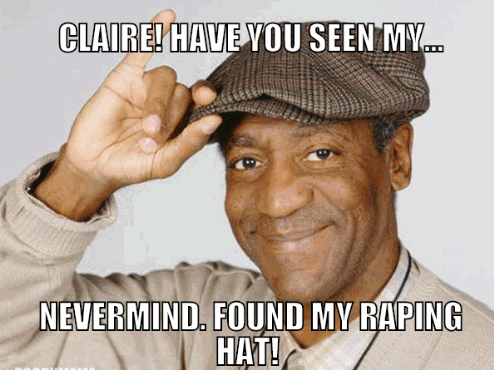
Well now it is a different time. A time of social media. A time of a lil bit more (a tiny bit, like, fuckin infinitesimal) understandin a sexual assault n its victims. N this shit aint goin away Billbo Baggin Sleepin Women. Yer upcomin NBC show? Cancelled. Yer comedy special on Netflix? Cancelled. Reruns of The Cosby Show on TV Land? Pulled. Your position at Temple University? Gone. That perfect Dad image ya delicately crafted fer 40 years? Ruined.

View image on Twitter

View image on Twitter

View image on Twitter
Fer better or worse, memes make people aware a issues in a way that news articles jus can't touch. 
Damn I love social media.

Dahh well! Should we feel sorry for him? Should we feel sorry for ourselves now that we can't enjoy a part a our childhood like we used ta? Answer ta both: fuck no. Fuck him n fuck you. Tha only people that deserve sympathy are tha victims.

But thats tha effect a rape culture. It makes us start ta believe shit like tha real victims aren't tha ones who were raped, tha real victims are tha guy accused a rape. We find reasons fer it happenin. She shouldnta been with him at night dressed like that. She shouldnta been drinkin. N it goes beyond jus rape. Its like every violent crime now. Blame tha unarmed guy fer gettin killed. He committed a crime 5 years ago. He had marijuana in his system. It's evrybody's fault but tha guy who pulled tha trigga.

It's crazy tha lengths people go ta blame victims, rape victims especially. Always talkin bout what she shoulda done ta avoid it. Why should she have ta adjust her entire life accordin ta tha oppression she faces? Dont question tha fucked up behavior a men or why society accepts it, question her fer not bein able ta avoid it? Seriously, fuck is wrong wit yall?

It's time ta accept tha realities a tha rape culture we hav allowed ta grow n flourish, n it's time ta accept that a lotta our idols ain't who we think they are, or who we want them ta be. A lotta  us learned that wit Joe Paterno, but we also saw some muthafuckas refuse ta learn that lesson n what they are willin ta do ta avoid reality...


Fuck Joe Paterno. Fuck Bill Cosby. Fuck rapists n rape apologists n Men's Rights fuckin Asstivists. N fuck these assholes who think their fame, money, or power or all three will protect them forever from any consequences.

Maybe yer askin how im so certain ole Bill is a piece a shit. I could just say I can do minimal fuckin research n fuckin read n anyone who can do those two things should be able to make up their fuckin minds at this point, but I see where yer comin from. Its America, innocent until proven guilty n all that. N thats a great theory, we jus never follow it. I get tha appeal tho. Justice is blind and treats errbody equal n nobody should make up their mind until tha court does n then tha decision has to be accepted as truth. Nice n simple right? Well, besides tha fact that jurors are fuckin ignorant about tha law, n money buys a better chance at justice, n mistakes happen all tha time, n tha court system is hilariously (maybe not so hilarious tho?) broken in general, rape accusations are a bitch ta prove in court. So, many times, victims settle outta court ta avoid tha intrusion inta their personal lives, like Constand in 2006.

In her case, since they settled outta court, tha 13 other accusers aint have ta testify. Many a those same women are comin forward, along wit many others, after my man Hannibal Buress blew Ole Bill's spot up in a stand-up act in Philly. These women got no hope a gettin money from him or even a conviction. They literally get nuthin outta this except peace a mind...n horrible fuckin people accusin them a lyin n deservin wutever they got n sayin they r just doin it fer money. Then ya got assholes always askin why they waited so long ta come forward. Well, besides tha reasons i already listed (like tha fact that nobody wants ta admit publicly they were violated n then hav ta deal wit all tha doubt n accusations a lyin) THEY FUCKIN DID COME FORWARD BEFORE. N NOBODY WANTED TA HEAR THAT SHIT! So, question fuckin society, question our fuckin selves, before question them.

Oh, n now there is another lawsuit by a whole different person. This one could be tha one that takes Billbo down too, cuz tha woman was a minor when it happened, n statute of limitations don't apply. I hope she gets ALL yer money Bill, ya sick fuck.

I've heard people defendin him like they know him, when all we know is his act. His act was great (well, The Cosby Show n Fat Albert n Ghost Dad were great). That shit don't mean HE is great. Big fuckin difference. People got a hard time separatin tha artist from tha art. He plays a funny, friendly family man, so he gotta be one in real life! What kinda logic is that? Christian Bale played a fucked up crazy psycho in American Psycho, but that dont mean he's crazy in real life.

Ok, bad example, but ya get wut Im sayin.

N Cosby did sum great things in life, fo sho. Still dont make this shit any better. Wen u rape or kill, all tha good shit u did gets tossed out tha window immedjutly. Hitler loved dogs (who dont, right? RIGHT?) but that dont pardon tha shit he did ta my Hebrew brothas n sistas nahmsayin?

Anyways, here's a few reboots tha Cosby team is workin on ta revive his career. I personally cant wait ta see all this shit!


The Cosby Show Me Where He Touched You

I Spy (A Rapist)

Gross Dad

Rapetown Saturday Night

Leonard Part 7: You Know You Want It

The Cosby Mysteries Continued

Fat Albert and The Gang Rape

Picture Pages and Pages of Rape Accusations


Ok, now it feels like an excuse ta write as many rape jokes as possible rather than jus shittin directly on Cosby, so let me finish by sayin this:

Fuck Bill Cosby.


Spread World Peace...Stop Willfully Protecting abusers.