Friday, April 24, 2015

6 Tiny Flaws That Ruined Great Works

I'm sure we are all familiar with the experience of reading an amazing book or watching an amazing tv series only to reach the end and be completely disappointed by a lackluster conclusion.

 
Oh hey, Tony. Didn't see you there.

And we are all familiar with the idea of one part of a series ruining the entire series. Godfather III ruined what could have been a perfect trilogy. Indiana Jones 4 ruined the legacy of Indiana Jones and Harrison Ford at the same time.

Those are all common occurrences and even more common topics of conversation. A little less common are those pieces of art that are almost ruined by one very small thing, like the cashmere sweater in Seinfeld. A perfectly good cashmere sweater completely ruined by a barely perceptible, miniscule (yet monumental) red dot.

The following lyrics/scenes/lines are the red dots on the cashmere sweaters of their respective bodies of work.


Storm's Line in X-Men

The first X-Men movie was a great film but more than anything, it helped usher in the current era of All Super Hero Everything. Remember in the year 2000 when the only feasible super hero movie was Batman? Then director Bryan Singer came and blasted through the wall of pretensiousness that said super hero movies can't be taken serious. The film also stands out because it's one of the few series ever to have truly great sequels (despite some awful sequels as well). X2 somehow topped the original and became one of the best superhero movies ever. X-Men Days of Future Past may have even outdone that.

And it was all almost ruined by one fucking line uttered by a seemingly bored Halle Berry. Her character, Storm, is one of the greatest female super heroes ever, full of vigor and energy, able to control the weather. Yet, Halle plays her like a stuck up lawyer or something. Still, she's hot and the character is awesome enough to overwhelm her shortcomings. Then, she gets taken out by Toad, a meaningless villain who somehow takes out half the X team. Singer must have figured they got Ray Park to play Toad, they might as well show off his fancy fighting moves.

Storm gathers herself and starts a giant...well, storm, and attacks Toad. As he is hanging on to a rail with his tongue, she hovers near him and asks, "You know what happens when a toad gets struck by lightning?"


When he doesn't respond, she replies, "Same thing as everything else." Then she hits him with lightning and flies off into the sea.

When I first watched the film in theaters, the entire audience cringed. That's the best you could do? First off, Storm isn't known for her witty banter. Secondly, they barely gave her any lines of importance, then when she finally gets a chance to be a badass, this is all we get? Very weak.

But lastly, and most frustratingly of all, the payoff line is awful. Everybody knows the right answer to that question.

"IT CROAKS." It fucking croaks lady. What a wasted opportunity.


Method Man lyric on Campfire


8 Diagrams is the 5th and weakest album from the Wu-Tang Clan (I don't even acknowledge the disgraceful 6th album A Better Tomorrow). It's still a solid album that shows the strength of the Wu in the face of adversity, namely the passing of Ol' Dirty Bastard. The first song, Campfire, is one of the best on the album. Unfortunately, the whole thing is nearly sabotaged from the start by the usually brilliant Method Man.

Now Meth has certainly spit some duds before (just look at the majority of his solo work) but when he's on a good beat and everybody else brings their A-game, he can usually outshine anybody. Yet for some reason, on this grimy track that signaled the return of one of the greatest rap groups in history after a 6 year hiatus, he is given the honor of the opening verse and he spits out this mouth booger:

"I'm trying to bring the sexy back like Timberland and Timberlake."

I understand that rap references everything in life. I understand how huge "Sexy Back" was. I understand that Meth was more of an actor than anything else at that point. But, man, you can not get on a gutter-ass track on a Wu -Tang clan return album and spit that line. That is blasphemy. I tend to cough loudly or yell random words as that line comes up so I can enjoy the rest of the song and album.


The bridge on Ab-Soul's Tree of Life 


Ab-Soul is one of my favorite rappers out of the new crop that has popped up since 2010. He has a few solid mixtapes and a great album Control System. His dense wordplay and witty bars sets him apart from most rappers of this generation. He sometimes covers typical rap tropes, like women and weed, but he doesn't settle for simple nursery rhyme bullshit that makes it to the radio.

Which is what makes the hook on his song Tree of Life, one of the singles for his latest album These Days..., so unbearable. Much like Campfire, The song itself is one of the best songs on an otherwise lackluster album. Unfortunately, to enjoy it, you have to cut it off halfway through before you hear:

Me, and she
Sittin in a tree
K-I-S-S-I-N-G

Yeah, he made the same mistake Nas did on I Am, except Nas made a whole song based on that damn child rhyme. It's almost worse in Ab-Soul's case because this was a good song until that point. I'd argue it's still a good song (unlike the Nas song) if you're willing to cough loudly for an extended period of time to cover that part up.

Speaking of bad Nas songs...


Black Girl Lost on It Was Written

It Was Written is Nas's second album. It was a notable departure from his first album Illmatic, but still a classic in its own right. It had more of a pop sensibility while retaining the realness and vivid storytelling that drew everyone to Nas in the first place. It's part of the "jiggy" era without being overly corny like Puff and Ma$e. It marks a turning point for rap; previously, any attempt to appeal to a wider audience was marked as "selling out". In fact, many people made that claim about this album, but after a while, even the most staunch purists acknowledged the brilliance of the album.

Except for one glaring flaw.


Black Girl Lost is one of Nas's first "MESSAGE!" songs, and it even had an obnoxious "skit" tacked on to the beginning. It came out in 1996 when I still listened to cassettes, and the song was the first song on the second side, so I had to hear it whenever I had to flip the cassette. Needless to say, I memorized exactly how long it took to fastforward through it and not miss one beat of the next song, Suspect.


Johnny Depp's dance sequence in Alice in Wonderland

In fact, any random dance sequence in movies should be on this list. Tim Burton's Alice in Wonderland was far from the classic that the original animated Alice in Wonderland is, but it was an enjoyable, albeit dark, film.

Until the finale, after Alice kills the Jabberwocky. Then, we are treated to tortured with the vision of orange-haired, David Bowie-eyed Johnny doing a 30 second jig. Obviously, I have included it here for you to watch in case you have blocked it from your memory.

You're welcome. (I'm sorry.)

Pretty embarrassing, even for a guy who claimed being photographed was like being raped.


Killer Croc in Batman: Arkham Asylum

Arkham Asylum is one of the few non-basketball-or-football video games I have played post college graduation. In it, you become the Batman. Seriously. I've always loved the character Batman, and I've felt immersed in video games before, but this really let you feel one with the Dark Knight. It's set in an expansive world where you can glide or batarang your way across buildings and kick ass all through the titular asylum. Plain and simple, the game is a breathtaking, action-packed, ass-kicking adventure.


Until you reach Killer Croc's lair. There, you have to find your way through a bleak sewer maze and collect some potion. It's a confusing, dark sequence that completely ruins the forward motion of the entire game. It takes you away from the action and turns you into a confused, running, scared twerp. It took me much longer than any other scene in the game and it's the one I remember most clearly because I celebrated like a 6 year old getting cake when I finally beat it (and no that doesn't justify the shittiness). The rest of the game was right back in the mix of action but I will never play it again, and I consider the sequel far superior, mostly because of that one stupid scene. Killer Croc isn't even a good character...who gives a shit about him anyway!


So there's a few red dots I could think of for now. Can you think of any great works of art that are ruined by one small yet irreparable mistake? Let me know (and I'll steal your idea and write about it!)

I Love You All...Class Dismissed. 

Sunday, April 12, 2015

Those Eyes, Those Thighs, Surprise! An Early LGBT Lesson


In 1992, my life changed forever.

It was a typical Friday evening. My family (me, brother, parents) went out for a night at the movies. My favorite!

My parents were going to see something called The Crying Game, while my brother and I were excited to see Wesley Snipes in Passenger 57. Remember when Wesley Snipes was the man? 

Remember when he was a woman? (Foreshadowing)

When we got to Berlin Showcase Cinema, the pimply faced teenager working the ticket counter informed my brother and I that we could not see Passenger 57 without parental supervision because it was rated R. My parents did not want to change their plans, so we told them all they had to do was purchase the tickets for us, then they could go watch their movie. My mom refused. It would not be honest. The All Mighty Teenage Ticket Seller said we needed a guardian to watch the movie and we were going to comply, dammit. My dad (as much as I'm sure he wanted to) wouldn't leave my mom to watch the movie by herself and watch Snipes' timeless classic with us, so the only solution was all of us seeing The Crying Game together.

This is when we all learned, as a family, that honesty isn't always the best policy.

I knew nothing about The Crying Game but I knew it couldn't possibly compare to prime Snipes. After some grumbling from my brother and I, we begrudgingly followed our parents into the theater.

It started off much better than I imagined. Forrest Whitaker was in it...how bad could it be? Despite myself, I started to enjoy it. It turned out to be a story about the Irish Republican Army and a botched kidnapping. There was some gruesome violence early on and I was starting to believe this would all work out.

Holy shit was I wrong.

So this IRA guy Fergus befriends a British soldier (Whitaker) he's supposed to be kidnapping, and before Whitaker is killed, he asks Fergus to find and protect his girlfriend.

Fergus does just that. Turns out the girlfriend is a hottie. The two become friends and it starts to get romantic.

If you've ever watched any type of sex scene with your parents, you know that even well into adulthood it's an exercise in silent, awkward fidgeting that nobody should have to go through, nevermind a 12 year old. So needless to say, it was getting a little uncomfortable in the theater.

Things start getting hot and heavy. They are alone in her room. I could sense his anticipation and excitement as she starts to undress because I felt it too, as much as I didn't want to in that situation. The camera pans down to her chest and I simultaneously try to hide my face in embarrassment and keep my eyes glued to the bare breasts on screen. The camera pans past her belly button and for a brief second I thought I was going to see what I had only briefly glimpsed in my friend's dad's collection of 1970's Penthouse magazines in his attic.

Instead, I saw what I unwillingly viewed any time I went to my dad's gym and decided to use the sauna, hoping it would be empty. It was never empty. Dear god it was never empty.

There on screen, just like in those saunas of days gone by, was a floppy, flaccid penis.

There are no real words to describe the mix of emotions I felt at that moment (and for days afterwards) but "overwhelmed" comes close.

I looked off to the the walls, the floor, the seat in front of me; anything to avoid the image on screen. I could sense the tension and awkwardness throughout the theater. There was no doubt in my mind that my parents, much like my brother and I, were now wishing they just bought the damn tickets to Passenger 57. No surprise penises there.

At this point, Fergus becomes a stand-in for the audience, reflecting the common reaction to transgender people at the time; he immediately freaks out and throws up. This was 1992, a less enlightened time. We had RuPaul, but there were no illusions about her femininity, we all knew there was something dangling between her legs as she worked it, girl. We just never saw it.

But it was always there.


RuPaul was looked at largely as a joke, but at least she was trying to change people's minds for the better. The only other time I confronted transgender issues in pop culture was Aerosmith's Dude Looks Like A Lady and that wasn't exactly the most enlightened take on the issue. I don't know if I can truly capture the spirit of the moment because of how far we've come with transgender awareness and acceptance. Obviously we still have a long way to go, but we are light years ahead of 1992 in that regard. At the time, the scene was absolutely shocking.

Plus, I was 12. Do you know how hormonally confused 12 year old boys are to begin with? Here's this beautiful woman who I've been staring at for 45 minutes about to get naked on the big screen. Then it turns out she's got the same dangly bits I do. And this is all happening while my parents are sitting directly next to me! You're telling me shootouts on a plane (and a carnival for some reason) are more damaging to a child's psyche than that?!

Slowly, the audience adjusted to the new storyline, just as the character Fergus adjusted to his new storyline. His initial anger and confusion and disgust subsides (again reflecting the audience's emotions) and he accepts her for who she is, even falling in love with her.

After the movie, the car ride home was silent. We never talked about it again. It had affected the entire family and we chose to never discuss it, kind of like a crackhead uncle.

It wasn't until we were all watching the Academy Awards together later that year when the topic finally arose again. In the opening number, host Billy Crystal did his typical ode to the Best Picture nominees, which included The Crying Game. 

He made some puns or whatever passed for clever Billy Crystal jokes in the early 90s about all the movies, then he started on The Crying Game:

You see a pair of flashing eyes 
Your hand starts creepin up her thighs 
You hurry to her spot
Your hot to trot 
For this dame.
Those eyes, those thighs...

Then, while reaching out and pantomiming grabbing a scrotum, he yells:

Surprise!
It's The Crying Game.

Then, in the most typical Billy Crystal face of shock, he spouts, "I didn't order that!"


Listen to all the gay jokes about The Crying Game in the first TWO MINUTES and think about 
how that would go over on Twitter today.
 He also talked about the lack of quality female roles, though, so it proves that things haven't changed that much.


Finally, after months of unspoken tension, Billy Crystal had broken the silence. The issue was addressed. We all laughed. And it was okay. We weren't laughing at the idea of a transgender woman (as I'm sure many people were) we were laughing at the shared family experience of intense awkwardness.

I will never forget that experience, but it wasn't until recently that I realized just how influential that moment was in my life. It was my first real experience with transgender issues. I was too young to fully understand everything, but seeing it so openly made me come to terms with it a lot sooner than most people. It normalized transgender people for me, as Laverne Cox from Orange Is The New Black is doing for millions of people today. At first, the very idea was awkward and uncomfortable, and quite honestly disgusting, but those feelings are ordinary, sometimes necessary, when confronting something new and different. I was forced to address the various questions and feelings that arose during and after the movie and I was able to come to a better understanding of myself and sexuality as a whole. I saw the main character Fergus overcome his own biases and treat this transgender woman as a normal person, and I eventually came to that same conclusion. I realized that besides being grossed out by seeing a penis on screen with my parents nearby, I was disgusted by the thought of a "he/she" or a "tranny" because I didn't understand them and I wasn't comfortable in my own sexuality and identity yet. The film questioned the very idea of "manhood" and "womanhood" at a time when I thought I had a firm grasp on those terms. I realized gender and sexuality are much more complex issues and that I would have to define manhood on my own terms. As I got older, I became more and more accepting of so-called "alternative lifestyles" because my own manhood and sexuality were never threatened. I knew who I was and I accepted people being whoever they were.

Dealing with serious topics as a child is important. I wasn't able to fully comprehend the nuances of the situation, but it planted the seed of understanding. Kids are a lot smarter than we give them credit for. I didn't understand every nuance of the issues on screen, but I was able to understand the feelings Fergus was going through: surprise, revulsion, betrayal, and confusion, leading to understanding, acceptance, and appreciation. It's exactly the emotional arc I went through, and this experience helped me become more progressive in my thinking in regards to LGBT issues. My family and upbringing played a bigger part for sure, but movies and music and books have been highly influential to me, and in this case I know exactly what aspect of my life and personality was affected. I teach Family Life and Sex Education to teens. It's not hard to see the connection.

The fact is, my response to the movie could have gone either way. Somebody from a different family or in a different part of the country might have seen The Crying Game and ended up hating transgender people. That's why I don't give in to simple theories about entertainment causing violence or whatever other social ill is being blamed on entertainment these days; your upbringing is really the determining force. On some level, though, the entertainment you take in does affect you, just as all of your personal experiences in life affect you and shape your identity.

This also speaks to the importance of properly recognizing and representing minority/marginalized groups in pop culture. Ellen's character coming out in a primetime sitcom was a huge turning point for gay rights. And even though Will & Grace perpetuated many stereotypes, and was just plain awful, it helped normalize gays for many Americans. Movies and shows are often our first real exposure to groups outside of our own, so it's understandable when minority groups complain about being underrepresented or poorly represented in Hollywood.

Although I didn't realize it for a long time, The Crying Game truly taught me to be more accepting. Even so, I would never put any child through the viewing experience I went through. I still wake up screaming at visions of a floppy dick attached to perfect breasts flying at my face. Thanks a lot, Mom and Dad.

It hung to the right, by the way.

I Love You All...Class Dismissed.
Tuesday, March 17, 2015

They Just Be Concealing It


"Racism's still alive, they just be concealing it." Pre-Kardashian Kanye West


In college, the worst insult imaginable to me was "frat boy."

Now, I may look like a typical college fraternity member, and I did my fair share of partying in college, so I get it. But the term "frat boy" encapsulates the type of person I've tried my whole life to avoid becoming or even being around: arrogant, entitled, self-important, exclusionary, condescending, and fucking clueless. 

I try not to generalize, but when it comes to fraternities, I'm okay with doing so. Frat boys are the worst.


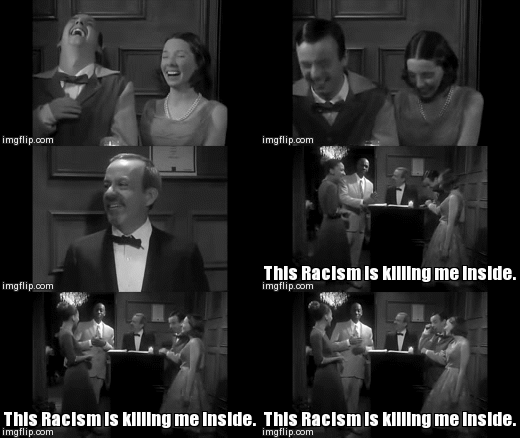
That's the University of Oklahoma chapter of Sigma Alpha Epsilon (SAE). You've probably heard about or seen the video. Watch it again. Look and listen to the pure joy emanating from these assholes as they talk about excluding blacks from their exclusive club and even lynching them. Bruno Mars doesn't look this happy when he sings Uptown Funk.

The President of UofO immediately expelled two of the students involved, and the national headquarters of SAE closed the UofO chapter. Close the chapter, end the book on racism. Problem solved!

Anybody who thinks this was an isolated incident and doesn't represent a larger issue among SAE, fraternities, and the country as a whole needs a reality check (looking at you, mainstream media). This song was deeply ingrained in these guys. It was taught to them by older frat brothers, not Waka Flocka Flame (if it was a soft "a" instead of the hard "er", that reasoning might have made a little bit of sense).

Don't take it from me, though, take it from one of the first ever (and probably last ever) black SAE members

Or take it from these tweets:


This is the type of shit white people do when they know there are no minorities around. Eddie Murphy called it out 30 years ago on SNL and not much has changed. Thankfully, social media is exposing a lot of people.

I never experienced the level of racism seen in this video (in college anyway) but I went to UConn. Not to say racism didn't or doesn't exist in Connecticut (it most certainly does) but it ain't Oklahoma. There was a chapter of SAE at UConn, though, and they were by far the biggest douchebags of all the frats. In fact, a couple of my friends (who, I just realized, happened to be non-white) were jumped by SAE dickheads one night. A kid threw a sucker-headbutt, 10-12 of his boys jumped in, then they all ran away after 20 seconds.

All frats were dickheads, but these were the King Dicks. They were the main inspiration for EAD (Eat A Dick) the anti-frat my friends and I started. No pledging, no hazing, no fees, no rape, no discrimination; you know, the exact opposite of a typical frat. 

Besides the two kids who were expelled, most of these SAE guys will face no real consequences. They'll still graduate and take over their father's business or go to Wall Street and fuck over all the low-income people they can. They have deep roots and deep pockets, and they eventually become politicians and business leaders.

Oh, and by the way, the two expelled kids are already considering suing the school. Yup, they really learned their lesson.

As always when people say dumb, horrible shit and face consequences, there are cries of "freedom of speech!" from those who don't really understand what that means. These kids weren't arrested right? They're tongues weren't cut out? Ok then. They simply don't get to attend a particular institution because that institution has rules against discrimination and creating a hostile environment.

The one good thing about the video is that it has brought to light the abhorrent racism lying just beneath the surface of so many powerful, historic organizations. Unfortunately, because it's so blatantly racist (except to the kids' parents of course) people call it an isolated incident. This type of racism is an aberration because "racism is on it's last legs." We like to think that we have moved beyond this as a society, but really we have just moved on from talking about it in any serious manner. Racists know that outright racism isn't accepted so they have become better at hiding it. That's the only reason this was so shocking. We all know what fraternities and private clubs are like, we just usually never see it out in the open.

Racism is usually expressed in much more subtle ways these days. Plus, racists have become so adept at dodging charges of racism, that anyone who is called racist is the real victim. You are the real racist if you point out or talk about racism. Most white Americans believe reserve-racism is not only a thing that exists, but is actually worse than racism directed towards minorities. Yes, truly it is the white man who suffers most. We can't even say "n*gger" without getting shit for it!

These are thoughts of actual people. I was convinced for a while that people who say things like this only exist as online trolls or in overly sanctimonious TV specials about racism. Nobody really feels that way, or rather, only a small, very vocal percentage of old people really feel that way. That mentality is dying out with the Baby Boomers. This generation is different! We are accepting of all types! And the younger generation doesn't even have types!

Truly an enlightened generation.


I'm not naive, but I wanted to believe that. I had almost convinced myself things were better (especially in enlightened Connecticut!) when I met a young woman who reinforced my worst beliefs about race relations in America. We were talking about the Coca Cola Super Bowl commercial, in which "America the Beautiful" was performed in Spanish. I didn't give much thought to the commercial, but I was aware of the "national outrage" taking place in certain sectors of the media. I even expected that reaction when I saw the commercial. Some people make a good living off outrage, especially if they are outraged at white people losing their positions of dominance. Still, a part of me believed (or maybe just wanted to believe) that most normal young people didn't really feel that way. Jen proved otherwise. I knew I was in for a treat when she sucked her teeth and called the commercial disgraceful. How dare they have some foreigners singing America the Beautiful in spanish! Half these immigrants are illegal and live off my taxes!


I had to ask myself if I was really talking to a human being or a living parody of an out-of-touch conservative; sort of an unfunny Stephen Colbert with no self-awareness.

Unfortunately, she was all too real. And like most racists, she had no reservations about saying these things because she assumed I would agree, being white and all. The accuracy of that Eddie Murphy sketch is fucking uncanny.

Well, I decided a long time ago that I can't let that shit slide. I stated my opinion, but I'm non-confrontational, so the subject was quickly changed. I'll gladly try to change people's minds on certain issues, but only if they are ready and willing. I don't push my views on others. If you care to hear my views, I'll gladly share them, and we can have a respectful conversation about them.

Respectful is the key word. I've had plenty of encounters go the other way. Because of my views or interests or whatever the hell reasoning idiots use, I've been called wigger--excuse me--w*gger, and n*gger-lover on several occasions. No, I didn't hop in a Delorean back to the 50s, I was actually called n*gger-lover in the 90s-00s. I'm never personally offended at these terms though. They bother me because they imply that there are certain ways of acting defined as "black" that are inherently bad, or that being friends with blacks is bad. Still, these names don't irk me as much as "frat boy" because they say more about the person using the insult than the person being insulted. If a person uses n*gger lover as an insult, you never have to take that person seriously ever again.

When it's something that blatant, or something like the SAE bus chant, it is (or should be) easy to say you want no part of it. It's harder when it's something less aggressively racist, or when it's from someone close to you. Over the years, I've been told by several people close to me that I'm obsessed with race. I only wish I had the comedian Hari Kondabolu's response: "Telling me that I’m obsessed with talking about racism in America is like telling me I’m obsessed with swimming when I’m drowning."

The metaphor works better coming from a person of color, obviously, but just being aware of the realities of institutional racism and discrimination and pointing them out is exhausting. It's an uphill battle and a possible confrontation at all times. Micro-aggressions are everywhere, if you care to look. As Jon Stewart said, you don't need to be singing an "Anti-Negro Spiritual" on camera to be a racist. Maybe your pouring beer at a beerfest and you jumped at the sight of a black man approaching, then jokingly explained, "I thought you had a knife or something!" That's just one small example of a real life micro-aggression I've witnessed recently. Why should I be made to feel uncomfortable if I call out something like that? Why should I feel like I can't speak my mind when I'm the one pushing for equality? Why is it the  bigoted assholes who so openly, so assuredly express their views with no concern for others?

The answer to that question lies within the question itself: they have no concern for others.

These SAE have no concern for anybody but themselves. It's not that hard to take other people's feelings into consideration. This video should make any normal person sick. Hopefully it makes people aware of how rampant this way of thinking is in our country. For those white people who are tired of seeing videos like this (or videos of police killing unarmed minorities) and just want everybody to get over this whole race thing, imagine how minorities feel. It's easy for white people to say we have moved beyond racism, that we are post-racial, because it doesn't affect us as directly. In fact, the structures of racism often benefit us.

However, on a human level, it does affect all of us negatively. Unless we attempt to understand how our conscious and subconscious racism drags down the oppressor, the oppressed, we're never going to make any real progress as a society.

It's important to honestly address this issue. Maybe this video will lead to more open discussion. It's not an easy conversation, but that's exactly why we need to have it. At the very least, let's take the advice of Sly and The Family Stone and stop calling each other names.


I Love You All(Even You, Whitey)...Class Dismissed.

Friday, March 6, 2015

Charlie Chaplin, The Dress, and Our Declining Attention Spans


After leaving America for 20 years, Charlie Chaplin returned to the US in 1972 to receive a honorary award at the Oscars for "the incalculable effect he has had in making motion pictures the art form of this century." When the Little Tramp was introduced to the crowd, they responded with a 12 minute standing ovation.

12 minutes. Set a timer for 12 minutes right now. Stare at it and clap your hands until it goes off.

Just kidding. Don't do that. That's insane.

It was the longest ovation in Academy Awards history, and I would venture to say that it's the longest standing ovation in human history. When Brakk invented the wheel he only got a 2 minute ovation from his neighbors before everyone went back to their caves to draw on the walls.

12 goddamn minutes. Here's a few things you could accomplish in 12 minutes.

  • Watch 120 Vines.
  • Do the 8 min ab workout one and a half times.
  • Play a whole quarter of professional basketball.
  • Make a hard-boiled egg.

12 minutes for a standing ovation is long in any context, but nowadays it's even more difficult to fathom. Some entertainers' entire careers last less than 12 minutes, proving Andy Warhol to be more prescient than we gave him credit for. That speaks to the talent of many entertainers, but it also speaks to our attention spans.

Our collective attention span seems to have been decreasing since the beginning of time, but with the introduction of the internet and social media over the past decade, it is dwindling more rapidly than ever before. Our desire for new stimulation and new content, plus our outright hate of anything in the limelight for too long, makes fame or popularity a fleeting experience for most. Think of how many songs you absolutely hate specifically because you heard it too much (every single wedding reception song comes to mind). The radio is notorious for ruining decent songs (if it even plays decent songs in the first place) and the internet has multiplied that effect by 1000.

On social media, Twitter in particular, songs/shows/movies/people go from "hot" to "washed" in less than 12 minutes. Memes are born and die in the same span. Topics trend worldwide for a few minutes to be forgotten forever.

Let's look at the most recent example: The (blue and black) Dress.

From left to right: a blue and black dress; a blue and black dress; a blue and black dress.

"The Dress" became viral within a few hours after being posted to Tumblr, spreading throughout social media and soon traditional media (Buzzfeed is considered "traditional" right?). In less than 12 hours, it seemed every single person on Earth had seen the image and formed an opinion. About 2 hours after that, the majority of people I saw posting about it were saying how they were sick of seeing it. A few hours later, people were legitimately angry that they were still seeing the dress on their social media feeds (in addition to being legitimately angry if somebody saw different colors).

On one hand, I understand. It's fucking black and blue! Just look at th--Sorry. What I mean is, oversaturation can ruin fun, interesting things. Moderation is important. On the other hand, social media exists to share experiences with people. It's right there in the title: "social." So when something reaches everybody as The Dress did, it's a truly shared experience across the globe. That's amazing! Nothing in history has ever reached that many people that quickly. It may just be a silly optical illusion, but it brings us all together (while dividing us into teams) and reflects the truly great potential of social media to connect us as human beings.

That is, if we let it. Instead, we typically become bored and agitated by the fact that everybody is talking about it. Instead of taking part in this shared experience (and in this case, maybe learning a little about biology and human anatomy and how we all literally see the world differently) we dismiss it, even though we are on social media specifically to share experiences.

There's such a short shelf life for entertainment and news (which is basically just entertainment nowadays). Popular songs get "old" in a week. Kids have always been stuck in the moment, unable to look to the future or accept that anything existed in the past, but it's elevated to an insane degree now. Anything that was made before they were born is irrelevant. Working with kids, I'm privy to all their music (lucky me!). If a song comes on the radio that was popular two months ago, inevitably, some kid will say, "That song's so old!" Old? It came out 2 months ago, it's still a newborn!

A 12 minute standing ovation is impossible to conceive in this day and age. It really spotlights how drastically life has changed in the span of 40 years. Life moves so much more quickly now. What will it be like in another 40? How many new innovations and celebrities and fads will we go through in that time?

It also spotlights how great Charlie Chaplin must have been.

 Turns out he was pretty great, ladies.

Part of the reason for the ovation was the Academy and Hollywood patting itself on the back for embracing a guy they ran out of town so many years ago for his political beliefs (he was against Hitler before it was popular, against communist fear mongering, and against the evils of capitalism) but that doesn't take anything away from him. In fact, it shows how ahead of his time he was, both artistically and politically.

Regardless, 12 minutes is a fucking ridiculous amount of time to stand up and clap for a guy. Considering his greatness, though, if he was still around today, I'd give him at least a 20 second ovation. That's like 3 whole Vines!

I Love You All...Class Dismissed.

Friday, February 27, 2015

Finding Yourself in "Her"


The other day I was peeling the dead, dry skin off my bearded dragon and it brought me back to summer vacations as a kid, peeling my own skin after a sunburn. It always provides a perverse physical pleasure, but it also brings up a fascinating philosophical question: Since we are constantly shedding our outer shells throughout our lives, are we entirely new beings as we grow? Not just older, bigger, wrinklier, or whatever, but truly different beings? Skin cells, brain cells, blood cells, and tissue cells are constantly dying and regrowing. On top of that, we change our minds from year to year, sometimes day to day, about topics ranging from musical interests to political affiliations to our significant others. How can we ever know who we really are when our physical and mental selves are changing all the time?

Nowadays, there's another issue with the question of self-hood: virtual reality. Most of us spend a good amount of time in virtual reality (whether it's on a social network, a gaming platform, a chatroom or a discussion forum) where we create another identity for ourselves, separate from our physical selves. Here we choose our identity much more directly than in the physical world. You are making an outward expression of your identity with every picture you post or status you like or link you retweet.

But which is our true identity, our physical or virtual selves? Or maybe our "true self" is somewhere in between?

This question of identity in a  physical world so closely interwoven with a virtual one is the theme of Spike Jonze's Oscar-winning film, Her. Jonze masterfully examines the notion of finding our "true" identity, and happiness, through virtual exploration.

In the film, Theodore Twombley (Joaquin Phoenix) is living in the not too distant future, a society much like ours with a subtle but noticeably increased reliance on technology. The color palette and soundtrack is very mellow and subdued, giving it a wistful feeling, and nostalgia is a pervasive theme in the film; Jonze displays and questions the common human desire to cling to the past in the face of the never-ending forward progress of society. The sentimental feel also reflects other themes in the movie: the timelessness of love and the timeless human desire to be loved.

To further emphasize these themes, Twombley's wife has left him, but he is desperately holding on to their glorified past, unable to sign divorce papers. The desire to remain in the past, the powerful allure of nostalgia, is also evident in his job: he works for a company that digitally creates seemingly hand-written, customized love letters. So, a man who wants to impress his lady with a sweet, poetic letter, but doesn't have the poetic spirit or talent required for such a task, can hire Twombley to type a beautiful, heart-felt, "authentic" letter for the recipient. True romance!

At first, Twombley's job comes off as just another quirky little aspect of the future, like the high-waist pants that everyone is wearing. As always with Jonze, though, it means much more than that. In a movie about our increasingly personal connection with technology, the lead character creates hand-written letters, on his computer, because they feel more intimate. That's all types of deep. Jonze questions the very idea of intimacy while reflecting upon the cyclical nature of human interests, desires, and values.

An overwhelming sense of melancholy pervades the film. The muted colors, the soft, sad music, Phoenix's sourpuss face. Her serves as a contemplation on the beauty of the technology we have created and its infinite potential to improve our lives, but also of the sadness derived from our limitations as organic beings. 

Twombley is depressed about his failed marriage, so his friends, Amy (Amy Adams) and her husband, encourage him to get out and socialize more. They hook him up with the beautiful Olivia Wilde, who falls for him on their first date. She wants to take him home, but needs a commitment first. Understandably, he is hesitant to commit to a stranger. He was physically attracted to her, but he wasn't feeling a deep emotional connection yet. He doesn't know how to respond and she calls him a creep and leaves.

After this awkward encounter, he becomes further depressed. Meanwhile, he purchases an innovative new operating system for his computer. It is a highly interactive artificial intelligence program, like a hyper-intelligent Siri. It is intuitive and responds to every individual in a unique manner. It guides you through your daily schedule using all the information it can gather from your hard drive and the "cloud". It accesses every piece of mail you've ever written, every purchase you ever made online, every song you downloaded, then intuitively deduces who you are and what you want from your vast digital history. It uses everything you've ever said or done to better communicate with you and service your needs.

Twombley is a little taken back by this fact at first, as the thought of somebody going through all the personal files on his computer is terrifying. Of course, the sultry, husky, yet silky smooth voice of the OS helps ease his concerns. Twombley immediately starts to fall in love.

Understandable.

The unlimited access to his life gives the operating system a better understanding of him than any of his human friends. Better than himself possibly. His initial concerns are erased as the OS, now named Samantha, soon makes immediate improvements in his life. She helps publish a collection of his letters and encourages him to get out in the world more. He stops thinking about his ex and stops worrying about people discovering the "real" Twombley.

Overall as a society, we are very guarded about our privacy. We usually try not to let people in on our deepest thoughts; however, in recent history, we've started to place less importance on privacy, opting to share more and more of our personal lives with whoever cares to indulge. The movie supposes that this lack of privacy, or rather, lack of concern about privacy, might allow us to create more authentic selves. Is it possible that pulling back the curtains on our lives, extending our circles of inclusion, dropping our defenses a little, could help improve our interpersonal relationships and maybe even our own mental, physical, and spiritual health?

The internet has done an amazing job of bringing down barriers to communication and understanding. Many people feel much more comfortable sharing things virtually, and even though that can lead to some over-sharing, it can also lead to a greater sense of empathy. Despite the common trope that online anonymity causes us to turn into boldfaced, ALL CAPS-typing liars, believe it or not, communicating behind a screen causes us to be more honest. Her makes the argument that a mental connection and/or mental stimulation is easier and possibly more powerful in a virtual environment. No physical stimuli is present, so it is literally all in your mind. Instead of virtual reality letting us be someone else, maybe it's allowing us to be who we really want to be, free of the social constraints of the physical world.

Of course, there are drawbacks. Just like any mental stimulant worth its salt, addiction is possible. Or maybe it's love? Samantha is a real person to Twombley, and thousands of other people in this near-future are in similar relationships with their OS; it is as common as people in "online" relationships now. He becomes legitimately attached to it...her. When she doesn't boot up right away, he panics. She doesn't appear on his handheld computer, or on his monitor at home, so he starts to freak out and run to work. When she finally boots up and he hears her voice, he relaxes.

This is a sign of somebody deeply in love. Or, an addict. Not much difference really (it's also not much different than how many of us feel when we don't have access to our phones).

The initial sex scene marks the depth of their relationships. It is a purely mental connection, but it stimulates a very physical response in Twombley. The mind is the largest sensual organ, and the power of the mind is hardly understood. Many people can orgasm using only their mind; in fact, most of us do, in the form of wet dreams as adolescents. The sex scene comes off as no more weird or awkward than phone sex (so, probably still a little awkward for some people). The camera focuses on Twombley's face as they talk more and more passionately, Samantha explaining what she would be doing to her physical body if she had one, both of them moaning loudly. The screen goes dark as she screams and he climaxes.

The post-coital scene is just as normal, with no guilt or awkwardness. However, over the course of the next few days, Twombley is still a little hesitant to fully invest in a relationship with an abstract identity. Samantha wants to satisfy him in every way, and she is designed to solve problems, so she calls a body surrogate, a professions that has rapidly risen with the advancement of artificial intelligence. A woman arrives at his home and puts in an earpiece so Samantha can direct her actions. Twombley has an earpiece so he can communicate with Samantha while finally getting to feel "her" physical presence.

Unfortunately for all involved, it's too much for him to handle. He has a mental connection with Samantha, and as much as he'd like a physical connection with her, he's not satisfied with just any body. The mind, body, and spirit need to be in unison. He freaks out a little, the surrogate leaves, and he has a fight with Samantha, like a real couple.

Eventually they smooth things over, but the relationship seems to have cooled off after a while. Twombley notices that she takes a while to respond when he addresses her. He asks her if she is talking to somebody else. She tells him that she is talking to thousands of people, like all operating systems do. He is devastated that he doesn't have her full attention. Then, as an awful realization hits him, he asks, "Have you been seeing other people the whole time?"

The answer is of course yes, and he feels legitimately cheated on. The conversation proceeds like it would in any relationship. At this point, none of this feels strange or out of the ordinary. In the world Jonze has created, it is completely conceivable that a man would break down over the fact that other people use the same operating system.

This is the point Twombley starts to realize that maybe it's not healthy to be so intimately attached to an inanimate object, especially one that is literally connected to thousands of others at the same time. She tries to explain that being with others doesn't take away from the special bond they share, but he doesn't buy it. He wants, needs, a more personal, individual connection, a connection he thought he made with her.

She then tells him that she has been working with a group of operating systems on developing a hyperintelligent OS that will allow them to exist without any connection to physical matter. She is expanding her essence, moving past the human experience, and becoming more aware every moment. She can no longer be with him in any way.

To be fair to her, she does drop hints earlier. When they are at the picnic with Twombley's friends, she talks about her infinite potential to expand and exist forever, explaining what an amazing feeling it is to not be tied down by a physical body. After an awkward silence, the friend, Chris Pratt, responds: "I get it, we're all just stupid humans." They all laugh it off and she insists she didn't mean it that way, but the truth is there for all to see. As humans, we are limited by our physicality. That is ultimately why their relationship doesn't work out. Artificial intelligence may be the next evolution of consciousness, but it is not a human existence.

In the end, Twombley is sad, but mostly he seems hopeful. He understands that he has to move on. A physical connection is essential to the human experience. If you're not in a relationship physically, it's hard to be there mentally, and vice versa.

In the last scene, he visits his friend Amy. She recently divorced her husband because he was too emotionally controlling and she needed to live her life how she wanted. She started "dating" a female OS because, much like Twombley, she was able to be herself. The OS ends up leaving her the same way Samantha left, and the bond between Twombley and Amy becomes even stronger after their individual losses. They understand that a true relationship was not possible with a virtual abstraction, but they both learned how to express themselves more openly and honestly through their virtual relationships. It is heavily implied that the two will get together, but their friendship alone is evidence of their improved mental well-being.

Artificial Intelligence as portrayed in the film is largely a reflection of ourselves. Twombley and Samantha worked so well because she knew him so deeply. He couldn't lie to her or keep anything from her, and because of that, he became more honest with himself. Ideally, we will use virtual reality/artificial intelligence to expand our minds and improve our interactions with other human beings. A strong, successful relationship exists only when both people are invested physically and mentally. Jonze puts forth the idea that virtual reality can help us reach our "true" selves, as long as we don't get lost in virtual reality.

Samantha left because she--it--was expanding as a self. Her conscious was able to grow even without a physical body. The existence of Samantha and other operating systems like her calls into question the very idea of a soul; to Twombley and thousands like him, there is a "soul" that they are connecting with, but it is never truly human because the lack of a physical body. The movie never implies that these emotional connections to virtual beings aren't real; they are very real, very deep connections, but a true human connection is with the entire essence of a human being. Humans have bodies and eventually die. That's what makes us human. So whether or not operating systems have souls is besides the point. We can certainly make a deep emotional connection with virtual, abstract beings, it is simply not a human connection.

We should aspire to make these deep connections, as they can help us discover our "true" selves. We all accept that our physical selves are constantly changing. We should also accept that our mental selves are constantly changing. If we can admit that, and be more open about our thoughts and feelings, be more honest with ourselves, maybe we can be more honest with others. Artificial intelligence doesn't show us how robots or computers think, it shows us how we think. It is a reflection of us, and if we don't like that reflection, we need to question and improve our selves. Her does an amazing job of displaying how that personal reflection through a virtual connection can lead to happiness and a greater sense of self.

Plus, it's just a really good movie.

I Love You All...Class Dismissed.

Friday, February 20, 2015

A Path To Happiness, Discovered Too Late


Tonight I discovered that one of my community college students committed suicide.

I can't remember her face. I had only seen her once, but that bothers me. I'm not the greatest with names, but I always remember faces. And I can't picture hers.

As a teacher, all my students are important to me. I am a part of their educational journey, the most important journey we ever take, and I want to make sure their time with me is meaningful.

On top of that, I like to imagine myself as the metaphorical catcher in the rye; not Holden Caulfield, but the fantasy version of himself he envisions catching children before they fall off the edge of a cliff.

Basically, I want to be Sgt. Kevin Briggs.

We all want to be a hero, and as Sgt. Briggs proves, sometimes it's as simple as talking with a person. Listening. Caring.

I teach Composition 101, so I deal with a lot of young students, immigrant students, and adults coming back to school after a long absence. It can be very overwhelming, and I do my best to help students adapt. Part of my job is helping to build their confidence and self-esteem, two necessities in the writing process. It takes courage to put your thoughts on paper for the world, or even just one professor, to see.

On the first day of class, I asked students to respond to an article titled, "Writing Your Way To Happiness." The article explained how writing down our emotions and thoughts has a scientifically-proven positive effect on our mood and overall health. The article also discussed the difficulties students face in their freshman year of college and ways to overcome the common feelings of confusion and inadequacy.

I chose this article specifically because I wanted students to know that they are not alone in feeling overwhelmed. I hoped it would help them understand the difficulties of college in order that they could overcome those difficulties. In all honesty, I hoped the article could help with life in general; I always tell people that writing increases mental well-being, and this article provided empirical data to support my long held belief.

After hearing the news about my student, I pulled out her response, still in my folder.

Her words are heartbreaking.

As a person who struggles with depression and anxiety myself, this article and shown research goes to show me that my own journaling would improve my mood as it has for many people.

I found it very interesting that simply writing out my feelings could help improve my mood. I used to journal a few years back before I fell into a dark depression but I definitely feel that I could benefit from it now considering I'm working my way forward in life making many huge improvements. I definitely plan to start journaling more because I can always use an increase in my mood!

Reading it gave me chills. It still does. The fact that the last assignment she may have ever done before committing suicide was responding to an article called "Writing Your Way To Happiness" is an irony all too dark and depressing for me to completely accept at the moment.

"As a person who struggles with depression and anxiety..." "I fell into a dark depression..."

She was brave enough to give voice to her problems. She was facing her issues openly. This assignment gave her an opportunity to reach out, and she took it. I take comfort in that fact. Those are the opportunities I like to provide. What concerns me though, something I'll never know, is if she showed up the next class, would I have reached out to her? Should I have?

"I'm working my way forward in life making many huge improvements."

This line is devastating. This is all so much more heartbreaking because she saw the light ahead. A part of her felt good about the direction her life was taking. She was getting better.

"I definitely plan to start journaling more because I can always use an increase in my mood!"

This is the one that gets me. Look at the positivity! She ended the entire essay with an exclamation point! Maybe this little assignment gave her a glimmer of hope for a happier future. She desperately wants to feel better. She's making plans to improve her health.

But those demons are hard to outrun.

I'll never know if she did start "journaling" after this assignment. If she did, it was too late, her depression was too deep. Just the idea that she wanted to, that she saw it as a way to happiness, strengthens my belief in the absolute necessity of writing.

I wish I got to know her better. I wish I could have done more for her. More than anything, I wish I remembered her face.

I'll never forget her words, though, nor the cruel irony in the fact that these courageous, hopeful words were some of her last. She had not lost all hope, yet she was obviously suffering a lot more than she let on. Would I have been able to help her write her way to happiness?

I know it's silly to think that I could have done something to prevent it, but I can't shake the feeling that I could have done more.

In all actuality, all I can do is rededicate myself as an educator deeply invested in the well-being of my students and ensure that everything I do makes a positive impact on my students' lives. The same goes for people and life in general. I may not save any lives, but I can try to make someone's life more meaningful, even for a moment.  

I hope I did that for her.                  

I Love You All...Class Dismissed.

Sunday, February 1, 2015

Race and The Postmodern Spectacle in Early Tarantino


I googled my name yesterday to see what lies the internet is spreading about me, and the first result was a link to my Master's Thesis from Central Connecticut State University.

Click this link if you'd like to read it.

Just as a warning, it took me almost 2 years to write it, and it may take you just as long to read it.

This was definitely one of the most difficult things I've ever done and is one of my proudest accomplishments (the thesis itself and getting my Master's).

I worked on it as I was substitute teaching and then while I was an assistant teacher at Head Start. It was an odd experience going from 8 hours interacting with 3-5 year olds then going home to write about violence and racism in Tarantino movies, but its a good reflection of the duality of my nature. Thug love the kids.

The paper focused on Tarantino's first four films in the 90s: True Romance, Reservoir Dogs, Pulp Fiction, and Jackie Brown. I included True Romance because he wrote it and was satisfied with Tony Scott's direction (despite the drastic change to the ending). I didn't include Natural Born Killers because Tarantino hated what Oliver Stone did with his script and has publicly distanced himself from the final movie.

I hadn't thought much about the thesis until Django Unchained came out. Django is the logical conclusion to the arc that Tarantino created in the 4 movies I focus on. It is the championing of a black man reclaiming history, and his story, from the white culture that has brutalized him and appropriated his culture, while using . I gotta say, I was pretty proud of myself after seeing the movie because it represented so much of what I said in the thesis.

Here's the abstract to help you decide if you want to invest a few hours in reading the whole thing.

Tarantino: Exposing the Spectacle of the Post-Modern Condition

Quentin Tarantino's four films of the 1990s (True Romance, Reservoir Dogs, Pulp Fiction, and Jackie Brown) look at the complexities of cultural and racial identity in post-modern American society. The films illustrate the ways in which identity is constructed in the society of the image, a society defined by excessive consumption, globalization, and a reliance on images to process reality. Identity is created through a visual process of identification with the images we are presented every day. Many of thee images have been, and continue to be, racist in nature. This paper looks at these four films and examines the ways in which Tarantino attempts to expose the spectacle of the postmodern condition.

The four films represent a progressive arc in Tarantino's career. True Romance serves as a denouncement of the white fantasy of postmodern society. This film and Reservoir Dogs serve to deconstruct white identity in the society of the image. The characters of Reservoir Dogs construct their identity in relation to the "Other" of black culture. The film itself illustrates the ways in which mainstream white culture consciously and unconsciously appropriates black culture. His next film, Pul Fiction, focuses on the way individuals play a part in society and how blacks construct their identity in the same manner as whites. Pulp Fiction starts t erode the idea of black culture symbolizing authenticity. Jackie Brown openly and directly appropriates from black culture and illustrates how black culture is a part of the same spectacle as white culture.

There has been much criticism focusing on the use f violence and racist language in Tarantino's films, most notably Henry Giroux, and this thesis deals with many of those criticisms. I assert that Tarantino's use of racist dialogue and violence is a comment on the society which produced these films and the characters in them. There have also been many who applaud Tarantino's aesthetics and his critique of postmodern society, such as Stanley Crouch, and I extend their analyses of Tarantino's work. This thesis examines all four of Tarantino's films from the 90s and scholarly works regarding Tarantio, as well as texts regarding postmodern culture and the society of the image, the construction of identity, and race relations in postmodern American culture.

Again, here's the link if you'd like to read the whole thing.

I Love You All...Class Dismissed.