
Showing posts with label teaching. Show all posts

Tuesday, March 14, 2017

You're Doing a Good Job


It's always good to get positive feedback. Some times you need it more than others. Sometimes you don't even realize how much you need it.

There's a scene in the very underrated movie Half Nelson where middle school teacher and crack addict Ryan Gosling is somewhat drunk and explaining to a friend how making a positive impact on just one student makes all of the difficulties of teaching worthwhile. If he can reach just one, he will be satisfied. Later, Gosling is very drunk at a bar and rambling to random people. A man recognizes him as his daughter's former teacher. This man's daughter is now going to college. She is studying history because she grew to love the subject in Gosling's class. He wanted Gosling to know that he made a huge impact on her life, but Gosling is so far gone he has no idea what the guy is saying. The guy eventually gives up, shakes his head and walks away.

It's a great scene that captures a phenomenon that I can relate to (no, not the crack thing). Gosling was clearly abusing drugs to fill a hole or overcome depression or avoid responsibility. He's at a point where he's doubting himself and his worth. He's overwhelmed by life. He can't see the long-term positive effects of his actions as a teacher, so he turns to the bottle and the pipe, which makes him feel like more of a failure, which leads him to actually become a failure (when you buy crack from your own student, you have failed as a teacher and as a human). When evidence of the impact he is making through his work is presented to him, he's too far into his vices and his own head and self doubt to recognize it.

I think about this scene a lot because it speaks to how I feel about teaching. It really is about reaching one person (hopefully a few more, but honestly just one). Although I haven't been in the grips of serious drug addiction, I certainly have moments of self doubt and feelings of not doing well enough. My fear is that I will become too lost in the daily grind and often excruciatingly slow progression to see the long-term value, and eventually, lose the passion to teach.

It hasn't happened yet, but I'd be lying if I said I haven't come close.

This semester has been tough for a number of reasons, most of them out of my control. My two classes have the lowest number of students enrolled in my entire time at Tunxis. Each class has been cancelled at least once due to weather. Plus, the country is currently being ruled by an egomaniacal madman and the state is in a serious budget crisis, so there's a general sense of malaise and doom that hovers above all our heads constantly. Or maybe that's just me.

There's also the typical issues to deal with, such as the few students in my class not showing up. There's an average attendance rate of about 70%. On the one hand, this is great when it comes to correcting papers: less work for me! On the other hand, it's not very encouraging as a teacher, or as a student for that matter. Students notice when other students stop coming, and it can affect their own attitude towards the class. When attendance drops from 16 to 12 to 9 people, it interferes with the class chemistry. I generally plan my classes with the number of students in mind. If I plan for 16 students to show up and only 9 do, I have to change things. It's not that big a deal, but on top of everything else it is frustrating. It doesn't exactly lend itself to lively class discussions. It's also incredibly discouraging when I take the time to correct a paper of a student who never shows up again. That is draining. It makes me wonder what's the point of correcting any of them?

The point is that one student. I was reminded of that the other day. As class ended, one of my students, a nice older Asian lady, approached me. She always sits in the front row and her text book is completely marked with highlighter and words in the margins. She is very eager to improve her English, which, quite frankly, isn't all that bad.

At this point in the semester, on top of the general feeling of disgust at the world, I was feeling a little disappointed in my own performance as a teacher.

I appreciate my job as an adjunct instructor and I truly believe that teaching is the most important profession in the world and we're making the world a better place and blah blah blah, but sometimes the nobility of the profession gets lost in the day-to-day labor. The work can be overwhelming at times, and progress is always slow and often minimal, so there's not often immediate positive feedback, as a teacher or student.

Not often, but sometimes. This was one of those times. And I really needed it, much more than I knew.

She expressed to me how happy she was being in my class with an opportunity to learn. She wanted to thank me for the work I was doing. In my mind, I was simply doing what I have for the past 8 years (8?!?! Holy shit!) and not even that well.

But my perception of my own performance didn't mean a thing to her. I was influencing her in a positive way. She thought I was doing a great job. She actually took the time, at 9:25pm on a Thursday, after 3 hours of class, to offer her gratitude.

"You're an excellent teacher. It's obvious that you care. You take the time to make sure people understand what you're saying. I almost quit because you were so intense the first day, but I'm so glad I stayed."

Her excitement at learning and her sincere appreciation for my help was palpable. I couldn't help but be infected with her positivity. All I thought the entire time she was talking was, "You have no idea how much this means to me right now."

It's barely halfway through the semester and I was feeling like it was finals week. I do my best to offer encouragement to my students as much as possible because I know they need it constantly to make it through a long semester. Well this time, the teacher...had become...the student.
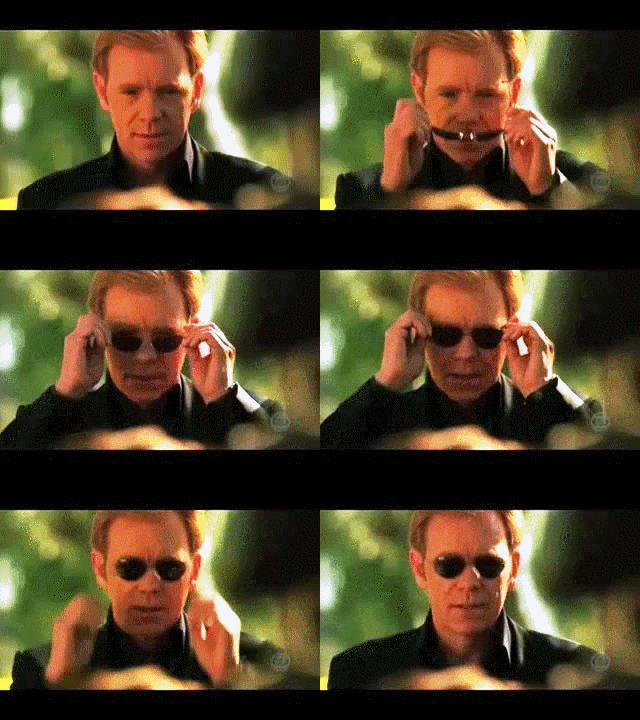


Yeeeaaaaaahhhhhhhhh!

The truth is, we all need a boost every now and then. Even the strongest among us need support sometimes.

When it comes to your profession, it's important to hold yourself to a high standard, but that can also lead to being your own worst critic. There needs to be a limit on how hard you can be on yourself. Sometimes, simply showing up and doing the work makes a huge difference, especially in a profession like teaching. As a teacher, I'm motivated to be the best I can be and I try to make classes interesting. But sometimes it doesn't happen. Sometimes lessons or entire classes can be lackluster. That doesn't mean they're not necessary or not making an impact. 

This lady, like the father in Half Nelson, let me know that I was doing a great job. Thankfully, I was able to recognize and appreciate the meaning of her words. I reached one student. I was successful. More than anything, though, her words encouraged me to do even better. If she thought I was a good teacher now, just wait until the rest of the semester.


Maybe you're thinking, "this whole post was just a way for him to brag that someone called him a great teacher."

My response to that is, ".....Yeah? And?"

I Love You All..Class Dismissed. 

Tuesday, September 6, 2016

From the Mixed Up Files of Professor Thug


School is back in session, and that can mean only one thing: teaching related posts from Professor Thug! Rejoice.

Teaching is awesome. Mostly. Any teacher worth their paycheck is also a student, constantly striving to improve. Whether it's taking classes, reading the latest research about teaching techniques, or simply learning from your own mistakes and successes. it's important to never become stagnant. Teachers need to adapt to the times and adapt to students' learning styles.

There are moments when I've reflected on a lesson or a response to a student and realized I could've done better. There are also times I've thought that I handled something really well. I learn from both situations. Everything can be a teachable moment.

I try to apply these teachable moments to my own practices. I've had many over the years, some more influential than others. A few happened before I was even a teacher.

The earliest was as a sophomore in high school. It's an example of how the best intentions can have the worst outcomes when they are not fully thought out.

I've had many bad teachers/coaches throughout my career as a student. Fortunately, I had many great teachers, too, but I believe you can learn as much from a bad teacher as a good teacher. With a bad teacher, you might not learn what they want you to learn, and you might be learning strictly out of spite, but you can always learn something.

I was playing organized football for the first time in my life. I was stuck on offensive line, a position I hated, but I wasn't yet confident enough to talk to my coaches and ask them to let me play literally anywhere else. So I stuck it out as Tackle for the full year. I practiced hard, I played hard, and I even cheered hard when I was on the sidelines, which was the vast majority of the time.

Near the end of the season, after our first loss, our coaches gathered us around for a pep talk. Some of the "stars" of the team had been complaining about playing time or something like that. The coaches saw fit to lecture us on good sportsmanship and persistence and sacrifice and blah blah blah. One coach got into a long rant about how the best players work hard without complaining. The playing time and the kudos come naturally because of effort and perseverance. If our "stars" really wanted it, they would go out there, work their asses off and not complain.

Then he turned and pointed to me: "Like Geoff here."


Oh for fuck's sake.

It didn't stop there. "He goes out there and practices every day and busts his ass. He cheers for his teammates. He doesn't sit there and whine about not playing!"

I don't know how many of the players were actually paying attention to any of this, but I do know that I was trying to hide my face and crawl into the corner. He just used me as an example of what an athlete should aspire to be, yet this asshole never fucking puts me in the fucking game. I didn't play one second that night. Maybe I should have been complaining. Or maybe, I don't know, he could have put me in the game? Does hard work and perseverance only pay off for everybody but me? Maybe the coach was just mocking me, like, "This guy works his ass off and he still gets no playing time hahaha!"

I finished out the year and never played football again. When I quit, the head coach (different guy) said, "You can't quit. You're our starting tackle!" To which I replied, "Coach, I didn't start one game. I barely played more than 5 minutes in any game." His reply, "Oh." I could tell right then that he barely knew who I was. That didn't exactly encourage me to stay, either.

Anyways, the entire experience was important for me because it taught me how not to treat students. Firstly, it's important to actually get to know your students. Secondly, if you're going to make an example of them, make sure you don't completely contradict your point with your own actions. Maybe if I played more than 4 minutes a game his point about working hard and being rewarded would have stood up. It was a punch in the face because it seemed that he knew enough about me to use me as an example of hard work, but not enough to let me play. So either I sucked or...I sucked? What was I supposed to think?

Oh, and not to mention, his stupid-ass point had no effect on the people he was trying to reach, so it was a double fail.

I didn't think I'd be a teacher at that point, but I knew I'd never use somebody like that. In general, I never use a student as an example of anything, good or bad. I've found that with writing, and with inexperienced writers in particular, exposure or attention can actually discourage them from doing their best work. People have told me directly that they changed their writing because they thought they might have to read it out loud or even simply share it with classmates in a peer review session. I certainly encourage them to share their writing, and peer reviews are mandatory, but I don't ever put the spotlight on someone if they don't want it. I might use a student's essay as an example of good writing, but most of the time I don't use the student's name. If I do, I ask them beforehand. It's just not worth possibly making a student uncomfortable. Any point I'm trying to make can be made another way.

Like this.

I acknowledge when someone does something well, of course, but I would never point someone out and tell everyone else to be like that person. That doesn't encourage anyone involved.

When I started working with kids, I didn't have a lot of instruction or guidance, so I tried to use my experiences as a student to guide me. To this day, most of what I do is try to emulate my best teachers and avoid what the worst ones did.

My first foray into working with kids was at New Britain Parks and Rec. I worked at the after school program at Chamberlain elementary school, helping kids with their homework and coordinating various fun activities for a few hours every weekday. One day, a young girl was upset about another girl making fun of her. I tried to calm her down and assured her that whatever the other girl said wasn't true. It was something about her glasses or braces or something, and according to the crying girl, it was accurate and she wouldn't accept otherwise. So I said something like, "When you get older, you realize it doesn't matter what people think. You'll look back and laugh at it."

She replied, "But I'm still a kid. It hurts now. You already were a kid so it's no big deal to you, but we have to go through it still."


Damn.

I vowed to never use the "you're just a kid/it won't matter in the future" reasoning ever again. It minimizes their feelings. Adults have the privilege of experiencing childhood and growing out of it, so we see how things evolve. They don't have that perspective. Their present is all they have, and their feelings are no less real than adults.


A few years later I was a pre-school assistant teacher. It was great, although physically exhausting. The age range was 3-and-a-half to 5-and-a-half. It wasn't exactly mentally stimulating, but it could be if you put mental energy into it. Besides proving my long-held belief that the best kids are someone else's, it taught me a lot about teaching and interacting kids. One thing I noticed was that young kids don't hold a grudge. They might start crying if you tell them no, but 5 minutes later they'll forget why they are crying and will ask you to play dinosaurs with you. You have to keep them stimulated; hence, physically exhausting.

One of the best teachable moments occurred while finger-painting. The best experiences always occur while finger-painting. Needless to say I was a master at it, and I wasn't afraid to show off my skills. Of course, working with pre-schoolers, it's more important to show them how to do something rather than show them how good you are at doing something, but I was new. And I had some finger painting skills to show off.

A girl next to me at the easels looked at my painting and said, "That's awesome!" (She was a smart kid.) Then she looked at her painting and started to cry. "I want to make mine look like yours," she said, with a full pout now plastered on her face. "I'm no good." The tears poured down her face.

I was silent. It was another Parks and Rec situation all over again, but this time, I was the direct cause of it. She was crying because of me, and crying girls have always been my Kryptonite.

The young girl next to her, who was a damn good artist herself for a 5 year old, noticed her classmate's distress. I'm sure she also noticed my utter inability to handle the distress.

She stopped painting and looked at the girl's work. Then she said to her, "It's okay Jasmine. Everybody has their own way of making art. That's what makes it beautiful. Your drawing doesn't look like anybody else's."

Jasmine wiped her eyes with her forearm and said, "Okay." Then she went back to slapping paint onto the canvas.

Ok, well...give that girl my check for the week.

That moment taught me more about teaching than most seminars or classes. Not only dd she have a factually correct response, but her tone and poise and her delivery was the perfect way to handle a tense situation. More than what she said, it was how she said it, and even more importantly, that she said it at all. She expressed concern in a way that avoided any melodramatic scene.

Meanwhile, I'm covering my face with my red and green and blue hands so nobody notices the terror and the tears forming in my eyes.

You have to reach students on their level. Oftentimes what may feel like a catastrophe can be handled with a simple, straightforward solution. "Avoid panicking" should be the number 1 rule for all teachers.

I've had many great experiences as a teacher, too many to mention. One of the best aspects of teaching is seeing students grow and become successful.

Recently I was at the bank and I saw a former student from Tunxis. He was working as a bank teller, and he told me he was studying Accounting at Central. He got his Associate's from Tunxis and was going after his Bachelor's at Central. He told me how much he liked my class and how he appreciated my help and encouragement.

Around the same time, I received an email from a former Tunxis student. She explained in detail how I helped her envision her own future...a future that did not involve school. She was working as a personal trainer or something and she was happier than ever. She thanked me for being honest with her about her performance in school. I always tell students that they need to truly examine whether or not they are ready for the commitment, in terms of time, money, and effort. Some people are just not willing or able to make the commitment, yet they sign up for classes because they think it is the "right" thing to do. It's only the "right" thing to do if it works for you personally. She realized she needed to take a different path to happiness and success, and she wanted to thank me for helping her see that.

That may not be what every educator wants to hear, but I always appreciate making a positive impact on someone's life, no matter how big or small. Students may not ever be great at a particular subject, but teachers can still educate them and make a positive, lasting impact. College isn't the right path for everybody, and trying to force everyone down that path is counter-productive. I'm very clear about the commitment it takes to be successful in my class and in college. If someone decides to continue down the path, I certainly do my best to help them succeed, no question. But if a student is taking Comp for the third time and he can barely put a coherent sentence together, school might not be for him. And that's OK.


Finally, there are some moments that make you question your profession as a teacher and sometimes even your existence as a human.

I'll only share one of those moments, and in all honesty, they don't occur that frequently. When they do, though, it is really devastating.

I'm a firm believer in the idea that there are no stupid questions. If a student has a question about something, there's a good chance other students have the same question and are just unwilling to ask it. Sometimes, students ask questions that can be frustrating because we have gone over them a few times. I've heard"what's a thesis statement?" too many times to count. I've heard "when is the first essay due" right after I just read the schedule enough times to give me an aneurysm. But I can deal with those. They are stu--strange questions given the context, but enough students ask to make me understand that it's a common issue.

However, there is one instance of a student asking a question that still sends shivers of rage and shame up my spine when I think of it. It was a stunning combination of bad timing and a complete lack of basic knowledge. If the question was asked at the beginning of the semester, I would have completely forgotten about it. In fact, it's a common, appropriate question at the beginning of the semester.

But it's also question I answer throughout the entire semester. I make the answer readily available on literally every essay's assignment sheet. It's one of the first things I tell students and I remind them every time a paper is due. After week 4, I've never had anyone ask me this question.

Until last semester. It was the last day of class. We had completed every assignment. Basically, the class session was designed as a writing workshop for students to put final touches on their portfolios. I was answering any last minute questions about revisions. A student at the front of class raised his hand. He wasn't the best student but he did all the assignments, attended almost every class, and participated regularly.

As I called on him, I was in no way prepared for his question. I thought it was a joke at first, but when I saw the look on his face, I knew that something somewhere in the space/time continuum had been completely disrupted.

The young man looked me in the eye and in all seriousness asked, "What font should we use for our essays?"

Me.

Again, if it was the first or second or even fifth week, this would be a reasonable question. If he had missed half of the classes, it might have been a reasonable question. If I required a different font for every assignment, this might have been a reasonable question. If he had some kind of traumatic brain injury, this might have been a reasonable question.

It was none of those things, and it was not a reasonable question and I think I might have frightened his ancestors with the way I stared directly into his soul with the fires of Hades ablaze in my eyes.

I could not believe it. I could not accept it. After this entire semeseter, after trying to teach these students so many things about English Composition, about critical reading and writing, about effectively expressing ideas to better engage with the world, this clowndick didn't know the most basic information? Information that had been given on the very first day and almost every day since?

Do you understand how that affects a teacher? If a student doesn't know what font to use on the last day of the semester, a fundamental requirement that had been covered over and over again, how could that student have possibly gained anything from this class? Was it all for naught? Did I just waste 3 and a half months of my time, his time, and 23 other students' time? Had my whole teaching career been a failure?

I stared at him in a silent rage for a few seconds then replied, "I'm not telling you."

He looked confused and a little sad. "What do you mean?"

"For every assignment throughout the semester I've told you what font to use. It's the same font every time. It's on the assignment sheets I hand out for every essay."

More silence and confusion. His eyes begged, "Please?"

"I can't do it. I can't tell you."

The other students looked on in embarrassment and pity. A student in the back spoke out, "Can we tell him?"

I replied, "I'm not going to stop anybody from helping out a classmate, but I personally can not tell him. I just can't do it."

Six or seven students immediately yelled out, "Times New Roman!"

He gave one of those, "Ohhhhh, right," looks and nodded his head.

"TIMES NEW ROMAN YOU DUMB BASTARD!" I yelled, lunging for his throat and stabbing him with a dry-erase marker in the left eyeball, turning his blue eye into a mess of bright maroon.

That's what I did in my mind anyway. I would've felt a lot better if I could've at least thrown something at him though. Instead I just nodded and said, "thank you everybody." And I meant it. The pity they all had and their immediate desire to help him made me feel a little better. They seemed just as shocked as me. So maybe it was just him. But holy shit, talk about a moment that makes you question everything. If I can't successfully instill one of the most fundamental rules of my class, how good could I possibly be?

Again, I think it was mostly just him, but it does speak to one of my beliefs about teaching. The teacher is only as good as the student. There are certainly great teachers out there and there are ways of teaching that are more successful than others, but a majority of people will fail or succeed no matter who teaches them. I know many teachers don't share that view, but I firmly believe it. My three hours a night for 15 weeks isn't going to overcome the 165 other hours of the week in which you are doing anything but learning. I simply do what I can for those three hours and it's up to each student to do the hard work inside and outside of class that truly helps them learn.

That's not a condemnation of teaching. At all. Teachers are some of the most important people in any society. But as I learned with that little girl in pre-school, encouragement and making a positive connection generally has more of a long-lasting impact on students than whatever specific subject you are teaching. My favorite teachers are my favorite teachers because of how they taught, not what they taught, and that is a lesson I take with me to class every day.


I Love You All...Class Dismissed. 

Sunday, May 4, 2014

6 Reasons Teaching is the Most Awful/Awesome Job in the World


I have worked as a teacher, in some form or another, for the past decade. I was a teacher's assistant at a preschool, and tutor for elementary school kids. I currently teach sex ed and family life (it's really just teaching life) to middle school and high school age kids at a teen pregnancy prevention program. I also teach English composition at a community college, where the students range from age 17 to 65 (or older).

I never saw this occupation for myself growing up, but I absolutely love it. However, like any profession, there are positives and negatives. Most of the time, teaching is awesome, but there are plenty of times when it's awful, just maybe not in the ways you might think...


6. Students are stupid


So, so stupid. It's a constant deluge of stupidity. No matter the age, if they are in school, they are there to learn, and before people learn something, they are dumb as hell in that area. Nobody is born with knowledge. That's why all babies are complete imbeciles: they haven't been taught shit yet, or even how to shit yet.

This stupidity...maybe that word is too harsh...this lack of knowledge in students is the most obvious example of teaching as a gift and a curse. Students can make teachers lose their minds with their seemingly endless stupidity, but they also prove every day why teachers matter: students need us. A middle school student once told me that yellow skittles work as birth control. I thought it was an isolated idiotic thought, but apparently she was not the only one with the ridiculous belief. In fact, I've heard most of the insane claims in that link. So yeah, I'm constantly reminded how important my job is.

Teaching keeps you humble (despite what this post so far might lead you to believe). You are constantly reminded how stupid you once were because sometimes the dumb shit that students say sounds a lot like some dumb shit you used to say. Plus, when students don't know something, and you don't either, you're reminded that you're still not so smart yourself, jerk.

The fact is, today's students are smarter than you and I, and definitely a lot smarter than the generations before us. But they are ignorant (or "need instruction" if you want to be nice) in whatever subject you are teaching. Sometimes, their ignorance of a subject allows them to have moments of brilliant insight. They are not bogged down by facts and traditions and the awfulness of reality quite yet, so their naivete and lack of training in a subject often lets them see that subject in a fresh, innovative light.

When I taught pre-school, we did a lot of finger painting. That was my shit. One afternoon, I was painting a picture with two 5 year old girls. Like an asshole, I did my absolute best work. It was as if the spirit of Basquiat had possessed me and decided to change the world through finger paint. When I was done, one young girl looked at it and said, "Wow, that's so good! I want to do that. Why can't I draw like that? Mine sucks!" and then proceeded to cry.

As I sat there like an idiot racking my brain for a way to make the tears stop falling from this innocent creature's eyes, the other girl said, "It's okay, everybody draws differently. Whatever you draw is beautiful because it comes from you."

Oh my god. Now I was about to cry. Thankfully, the girl wasn't anymore.

What more can you say to that? I handed the adorable genius my pay for the day and walked home with the knowledge that a 5 year old was able to create a teachable moment better than I could. Ok, I didn't do that, but maybe I should have.

It was a moment that made me question my ability, yet, it also gave me the desire to improve my abilities and made me understand that there is no profession like that of a teacher because...


5. You learn more than you teach


I was always a better student than anything else. I can take a test like a motherfucker. I can read mostly anything and understand it enough to write a whole treatise. But I was never as good as a student when I was actually a student as I am now as a teacher. That was a hell of a sentence.

There is a teaching theory/technique that presupposes that individuals learn more about a topic when teaching it to others than when simply trying to learn for one's self. In my experience, that is absolutely true. As a grad student, several assignments required us to teach the class about given topics, and I never learned more about a topic than when I had to prepare a lesson and conduct said lesson in front of the entire class.

As a teacher, you constantly learn about yourself, about others, and about whatever topics you are teaching. If you are open-minded (a good teacher should be) you will face the reality that you are frightfully incompetent in the very subject you teach. You may know a lot, but it's never enough. I learned early on to prepare more than I think I will need because anything I don't know will inevitably come up, and every student will be looking to me for the answer.

The shame you feel when you don't have a response is one hell of a motivator though. You never again want to see their expectant faces and disappoint them with your lack of knowledge, so you prepare even more.

Your own stupidity is just one type of motivation, however...


4. Its an honorable profession


No, I'm not trying to imply that the possibility of David Lee Roth singing to you in class should be motivation to teach. I'm not not saying it either.

This one gets tossed out a lot when discussing teachers. Everybody wants a job they can be proud of right? The importance of teachers is understood by society at large (mostly). We hear it all the time: teachers rock!

See? All the time.

Besides the obvious fact that honor and respect don't always manifest as financial stability, when thirty middle schoolers are all yelling at the top of their lungs and two of them have cursed you out before noon, society's respect means jack shit. A lot of kids look at their teacher as the enemy by default and stay in that mindset until they are out of school. I've heard plenty of parents talk about how they wished they treated their teachers better (I've said it myself) and it's great that they finally understand the importance of teachers later in life, but that doesn't really help when their son or daughter is calling everybody in class a fag while your trying to teach the Pythagorean theorem to twenty five 12 year olds.

If you're a real teacher, that's okay though. You'll deal with the worst and the best that kids have to offer and you'll deal with those who still disparage the teaching profession and you'll deal with the meager compensation. All of the negatives on this list barely even register on the scale compared to the positives. Teaching requires patience and empathy, but those are two things everyone should work on anyway. It really is an honorable profession, and part of having honor is accepting that you will not get rewarded for the job you do.

It's not about whether people notice you, it's about what you notice in your students...


3. You see progress. Eventually. Maybe


As opposed to a regular school teacher, at the teen pregnancy prevention program, I get to see kids mature and develop for the better part of a decade. It's amazing, and it's something I need to keep in mind on a daily basis working with the younger kids because progress isn't necessary visible day to day. It is happening, though.

Of course, when you do start noticing improvement and progress, cruel fate steps in: it's time for them to move on. Even after seeing them grow for 6-7 years, I sometimes feel like it's not enough. These kids who didn't know a damn thing about the world when they started are now bright young adults. You want to keep guiding them and helping them develop and you want to experience their lives with them as you have been doing for so long, but you have to let them go. An educator's job isn't finished until students can go out on their own, so we have to eventually let them do that. That's the goal from day one. When it happens, it's beautiful, but heartbreaking because now they have to move on with their lives without your daily guidance.

You can never get too upset, though, because there's always more...


2. The endless parade of students


This song doesn't have anything to do with this entry except that it has "Parade" in the title. I just like it.


...and more and more and more. And they all have the same issues as the last batch you taught, with slight twists that keep you on your toes.

When you are asked the same question literally a hundred times, the natural human response is to lose your shit a little bit. How many times do I have to explain what a uterus is people, jeezus!?! The thing to remember is that they haven't heard it a hundred times (unless you've told them a hundred times, which justifies shit losing). It's not their fault you have to explain the same topic to hundreds of students every year; to each new group of students, it's the first time. How are they supposed to know the topic? They came to you for that. It can be repetitive as hell, but it makes you try different methods and tactics so you don't bore yourself to death. You try to come up with the most entertaining and effective way to teach any given subject. Students need to be stimulated to learn, and everybody doesn't learn the same way. You have to use different methods to reach everybody; therefore, experimenting with different techniques to keep yourself sane is actually benefiting  the students as well.

Teaching requires a concerted effort. It requires getting out of your comfort zone, unless your comfort zone is talking to 30 strangers that hate you by default because you're giving them work. I'm not a big conversationalist, but I've learned that it's important to engage kids in conversations to get them interested in learning. I've also learned that opening up to students, showing them that you're not afraid to look foolish by telling an embarrassing story about yourself or doing something silly is the quickest way to a student's heart. They have to trust you to learn from you.

I've always believed that getting out of your comfort zone is vital to leading a rewarding life, and sometimes being forced to do so is necessary. Just because my philosophy is to get out of my comfort zone, it doesn't mean I voluntarily do it often. When it comes to teaching I do, however, because the rewards are plentiful, and the effort is well worth it.


1. They will idolize you


This mostly applies to younger students, but if you make a connection with them, students will absolutely idolize you. Awesome, right? Everyone wants to be an idol, that's the whole reason American Idol exists.

It definitely can give you confidence and self esteem to be looked at as an all-mighty bestower of knowledge: "Look at this youngster coming to me for advice...I'm the man!" you might think.

But then...

"Look at this youngster coming to me for advice about whether or not to have sex for the first time...Oh shit. Oh shiiiit." I have thought.

Why are you putting your faith and trust in me? I can't even decide what to eat for dinner every night. What I say could affect this person's entire life and possibly the life of another human being (or two if they don't use the condom I give them). What if I say the wrong thing?

You very well may say the wrong thing (when it comes to an opinion; if it's a fact-based question and you're not sure, use Google dammit!) but if you are doing your best to look out for the kids while allowing them to keep their own sovereignty, then it's all good. They barely remember what you say anyway, it's how you say it, and most importantly, that you say it at all. They remember you being there for them, not the exact words that come out of your mouth. And when they screw up, the urge is to give them a grand lecture that will make them regret their actions, but for the most part, if they messed up, they know they did; they just need to know that you will still be there for them despite their mistakes. Don't let them off the hook, but don't act like they're the first ones to ever misbehave or make a mistake.

The greatest thing about the job, though, is that you end up idolizing the students. Life is unbelievably difficult for an unacceptable amount of children in this country, and when you get to know your students and understand what so many of them have to go through just to get to school, the resiliency they show is truly inspiring.

If you teach long enough, and you get to watch wave after wave of students grow into intelligent, successful individuals, it's more rewarding than any other job in the world.

I Love You All...Class Dismissed.

Thursday, June 14, 2012

Lives of Dedication

Last night I had the honor of attending the retirement party of the Superintendent of Schools in New Britain, Mr. Ron Jakubowski. Mr. Jake is also the father of my life associate and college roommate, so I've known him for quite a while, in various forms. Mr. Jake is beloved in the town where he spent most of his professional life, his hometown of New Britain. His retirement party was overwhelming; it was the largest retirement party I've ever seen or heard of. There were about 14 speakers; they all talked about his dedication to the youth and his commitment to the people he loves. He is the man and he deserved every good thing said about him. He also deserved to have the baseball field at Jefferson Elementary named after him. A more fitting tribute does not exist.

The night was a great tribute to a great man, and it got me thinking about my parents' retirement parties. I don't remember my father's retirement party very well. It feels like he's been retired for about 20 years now. I can't even remember what he did (a running joke with my friends is that nobody ever really knew what he did). I know he played golf a lot...

I'm kidding of course. He worked at Capital Community College; he was an educator, like Mr. Jakubowski. The little bit that I do remember about my dad's retirement party was that there were a lot of people (there are a few special events I have in mind that could have been his retirement party...when you're a kid, all events where you have to get dressed up and spend the evening with adults are exactly the same). What I clearly remember is a plaque that was presented to him that praised his positive influence on the lives of countless people throughout the years. That same theme was repeated last night. The same theme was repeated at my mother's retirement party about 10 years ago. My mom was also an educator, and there were a lot of people at her party as well. Her party was the first time I clearly saw how many people loved my mom and had been affected by her in a positive way. It was the first time I truly considered how much educators can influence people's lives. It was a very powerful moment, not only because of the love shown for my mom, but for the love shown for the profession. People were simultaneously celebrating her dedication to the craft and to the youth, and mourning the loss of a passionate, caring educator.

Before the dinner started, my aunt suggested that I speak during the event. I didn't really plan on speaking; I didn't want to go up there in front of all these adults, teachers at that. But everyone was so emotional and my aunt and a few other people were giving me the "you don't have to speak, but we'd all be disappointed if you didn't" look, so I walked up to the podium. The first thing I said was, "With all these kind words about my mother, it's obvious none of you people have lived with her for over 20 years."

That killed. Seriously, I know it's not that funny just seeing it written, but the crowd loved it. I mean, all night people were getting choked up, some were even openly weeping. The varsity football coach made a speech and he was crying. People were dying for a laugh.

But I was serious, in a way. I was trying to get to a larger point about my mom and about teachers in general. There were many times growing up that I thought my mom was being overly strict...and slightly psychotic. But that was the educator, and mom, in her. She wasn't trying to be my friend. She was trying to make me a better person, every day. To her, every moment is a teachable moment. Another thing I said in my short speech was that my mom never stopped teaching; not when school was over for the day or for the summer, and not after retiring. Even on the way to her retirement party, she was teaching me, asking me about my writing and telling me to keep at it, to keep trying and keep pursuing my dream.

That's the thing about good teachers and educators: their jobs are never over. They don't work a 6 hour school day, they work 24/7, 365. I had the benefit of having two educators as parents. Growing up, I didn't really see that as a benefit, but that's the ignorance of youth. You don't really appreciate the people that make a difference in your life until you're older. That's why teaching is so often a thankless job...until your retirement party. I remember the love my parents received from their coworkers and from the people they tirelessly served, and I saw the same thing again last night. You don't always have the chance to thank people who have influenced you, or to tell people how much they mean to you, but retirement ceremonies are a place to do just that. As the M.C. told Mr. J last night, "the next time everybody will be here for you is when you're lying horizontally in a box." (Or something like that...it was much more eloquent and funny when he said it). Too often we wait until the person is dead to celebrate their lives; fortunately for Mr. J, and for my parents, their lives of dedication were celebrated with them in attendance. They were able to see firsthand the number of lives they have touched, and now they can enjoy the rest of their lives with the knowledge that their hard work and dedication meant so much to so many.

Here's hoping all good educators have that opportunity.

Congratulations Mr. J, aka Big Poppa Weedle.

And thank you, Mom and Dad.

I Love You All (Especially Educators)...Class Dismissed.